


Who keeps the benefit of a warmer rented home?
A retrofit can improve a building without distributing its benefits fairly among current tenants, owners, future occupants, and public funders. This methods note develops a distributional account using Davis’s original appliance-adoption analysis, Fowlie and colleagues’ weatherisation evaluation, and the Magenta Book. A fictional rent-and-bill example distinguishes lower energy expenditure from lower total occupancy costs, while an underheated household illustrates the difference between reduced consumption and improved comfort. The analysis maps authority, payments, disruption, maintenance, and benefit timing, and separates participant transfers from societal resource costs. No housing performance or savings are estimated. Its practical implication is that credible retrofit offers need transparent charging, protection, operational responsibility, and evaluation of who actually receives the intended housing outcomes.

A data licence cannot grant consent
A public licence does not summarise every permission governing research material. This practice essay compares Creative Commons Attribution 4.0 legal terms with the National Inuit Strategy on Research, TCPS 2 Chapter 9, and the CARE Principles. A fictional archive containing instrument measurements, place descriptions, and interview excerpts illustrates why possession, copyright authority, individual consent, collective governance, and repository access must remain distinct. The analysis examines irrevocable public grants, incompatible downstream restrictions, attribution without endorsement, and material excluded from a blanket licence. It provides neither legal advice nor a universal Indigenous permission process, and makes no claim of community approval. Clearer separation of objects and authorities can support legitimate reuse while avoiding promises that a repository is not entitled or able to make.
Converting glacier mass change without changing the claim
Glacier change can be expressed per unit area, as total mass, or as a global mean sea-level equivalent, but these quantities support different comparisons. This methods note synthesises the IACS mass-balance glossary, World Glacier Monitoring Service reporting, and NASA sea-level explanations. Fictional glacier calculations demonstrate how rankings reverse between specific and total loss, how sign conventions change between glacier and ocean accounts, and how area uncertainty affects a conversion. The discussion separates rates from cumulative change, water equivalent from surface lowering, and global accounting from local relative sea level. It supplies no original ice-budget estimate or attribution. Its practical result is a reporting sequence that retains dates, area convention, boundary, original units, and uncertainty so a useful translation does not silently become a different scientific claim.
What a decibel number needs beside it
A decibel value becomes comparable only when its physical quantity, reference, frequency support, averaging interval, and calibration are known. This methods note synthesises laboratory guidance and acoustic-methods research to distinguish sound pressure level, peak measures, sound exposure, and spectral density. Hypothetical calculations explain the conventional reference difference between air and water, the effect of duration on exposure, and why averaging logarithmic levels can differ from an energy-equivalent average. The discussion also separates received levels from source levels and pressure measurements from particle motion. It does not establish current regulatory thresholds or biological equivalence between equal exposures. The practical result is a reporting minimum that prevents an apparently precise acoustic comparison from concealing different quantities, processing choices, or measurement limits.

Repair when remaining life is a range
Repair decisions combine a visible quote with uncertainty about restoration, subsequent failure, software support, and the consequences of downtime. This methods note separates those questions through a fictional smartphone case with explicitly invented prices, probabilities, and service periods. European Commission smartphone requirements and repair-policy guidance establish relevant institutional conditions, while the GHG Protocol Product Standard informs the environmental boundary. The analysis explains why expected months are not guaranteed service, why cost per expected month is incomplete, and why deferred replacement must not be counted automatically as permanent avoidance. Financial vulnerability and access needs remain independent constraints. No model-specific reliability or climate benefit is estimated. The proposed conversation connects diagnosis, a defined service horizon, enforceable support, and responsibility for adverse outcomes.

Designing the overlap between instruments
Replacing an instrument can improve measurement while disrupting a long record. This methods note synthesises GCOS change-management principles, NIST traceability policy, the JCGM uncertainty guide, and Arctic observing-network context to examine what an overlap period must establish. A fictional temperature comparison demonstrates how a small mean offset can conceal a scale-dependent difference. The analysis treats condition coverage, measurand equivalence, time alignment, correlated pairs, uncertainty in both instruments, and reversible corrections as distinct design questions. It separates calibration, numerical continuity, and validation, and explains the additional limits when simultaneous comparison was impossible. No universal overlap duration, sample count, or calibration procedure is proposed. The aim is a bounded statement of comparability supported by preserved evidence before retirement makes that evidence unobtainable.
When conductivity does not mean saltier water
A conductivity change is not a direct measurement of changing salt content because temperature, pressure, units, and seawater composition affect its interpretation. This methods note follows the documented TEOS-10 calculation chain from conductivity to Practical Salinity and Absolute Salinity, then to thermodynamic interpretation. A published Gibbs SeaWater demonstration supplies two nearly equal conductivities with substantially different calculated salinities, making the importance of context explicit. Hypothetical archive and mooring cases show how a convention change can create an artificial step and why validated freshening does not uniquely identify its source. No field deployment or calibration is analysed. The note identifies the variable definitions, original inputs, processing versions, and quality information needed before a profile can support claims about water masses, density, or freshwater pathways.

A break-even point with blanks left in
A replacement product’s operating efficiency does not establish when its additional manufacturing emissions will be repaid. This methods note constructs a conditional break-even model for a working desk light while leaving unsupported parameters explicitly unknown. The GHG Protocol Product Standard, European Commission energy-label guidance, and UK conversion-factor methodology inform the treatment of service equivalence, electricity boundaries, and comparison limits. A hypothetical contrast between two operating schedules illustrates sensitivity without assigning a real footprint. The analysis then considers changing electricity supply, remaining product life, later replacement, and unmatched service at the horizon. No numerical break-even date or saving is claimed. The practical outcome is a decision record that distinguishes useful conditional arithmetic from an environmental conclusion requiring product-specific evidence.
When a second sensor is not a second network
Instrument counts alone do not establish observing-network resilience. This evidence review combines the Arctic observing-network assessment, GCOS monitoring principles, and measurement-uncertainty guidance to distinguish redundancy for availability, accuracy, coverage, and timely delivery. A fictional reliability calculation contrasts independent failures with two instruments sharing a vulnerable platform. Further analysis follows common dependencies through calibration, software, archives, funding, and specialist expertise, while distinguishing environmental correlation from correlated measurement error. The review considers removal experiments and irreversible gaps in long records without ranking actual investments or specifying operational safety coverage. It also rejects treating community-led observation as an interchangeable spare component. Redundancy is most defensible when it protects a named evidential function through an independent, authorised route whose limitations are documented.
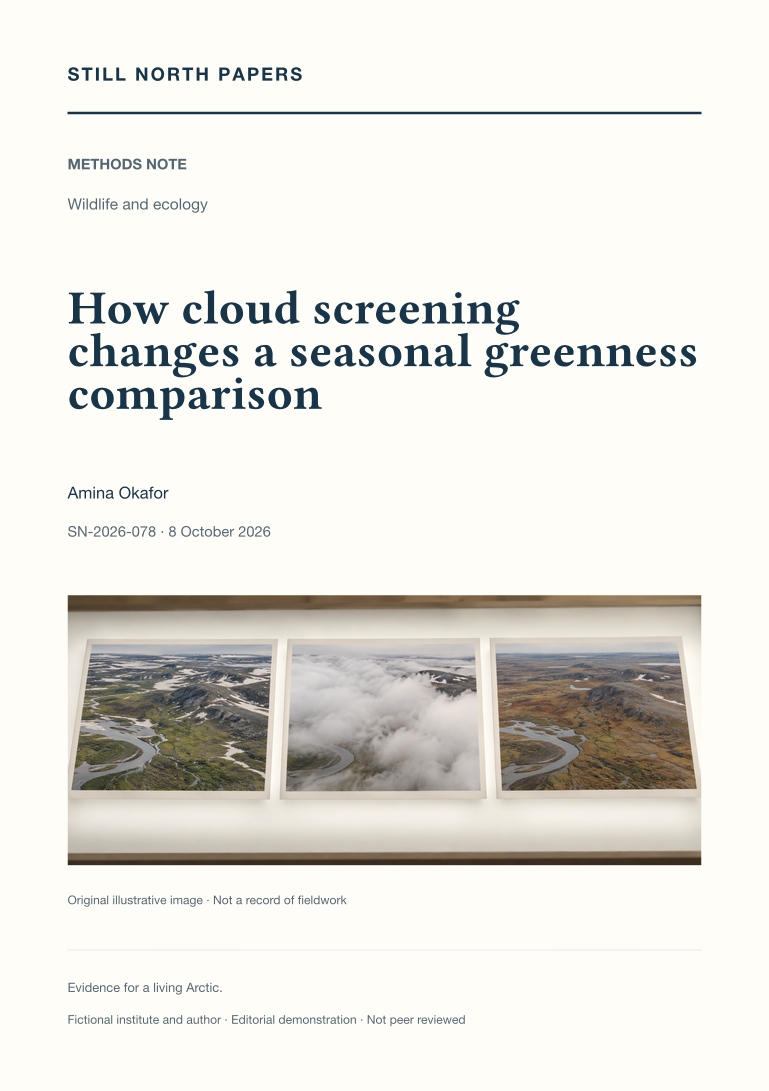
How cloud screening changes a seasonal greenness comparison
Seasonal vegetation composites summarise retained observations, not an equally observed season. This methods note synthesises MODIS compositing guidance, Landsat quality-band documentation, and NOAA tundra-greenness methods to examine the interaction between cloud screening and ecological comparison. A fictional pixel history shows how an unseen peak can lower both observed maximum and available-observation mean without any underlying vegetation change. The analysis distinguishes seasonal statistics, selected observation dates, quality thresholds, reconstruction, changing spatial footprints, and cross-sensor support. It proposes coverage diagnostics and sensitivity comparisons that remain tied to the chosen question. No imagery is reprocessed and no published Arctic trend is re-estimated. The conclusion is that greenness results become more interpretable when observation timing, masks, and fitted values accompany the statistic rather than disappearing inside a seamless map.
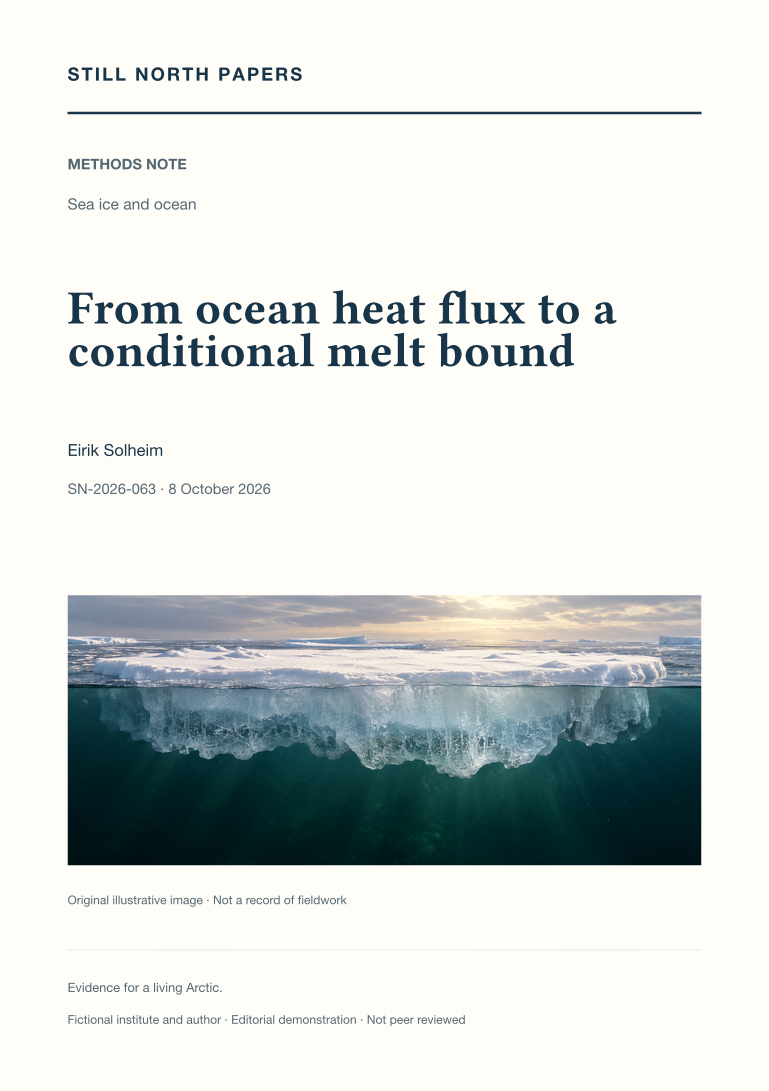
From ocean heat flux to a conditional melt bound
Converting an ocean heat flux into centimetres of ice can check physical scale without predicting sea-ice loss. This methods note uses published ocean-ice heat-budget research and the TEOS-10 framework to derive a conditional latent-melt equivalent. A hypothetical flux of ten watts per square metre over thirty days supports approximately 8.6 centimetres under explicitly simplified property and energy-allocation assumptions. Further cases show how conductive export, duration, area denominator, and reduced winter growth change the interpretation. The note distinguishes a bound on one specified energy contribution from an unconditional bound on total melt. It does not estimate a present Arctic flux or attribute observed retreat. Its reporting framework keeps system boundaries, counterfactuals, thermodynamic approximations, and unmeasured transport beside the calculation.

When sharing changes demand: a rebound audit for community services
Shared ownership can change demand as well as the resources required for a fixed service. This methods note uses a fictional equipment library to examine purchase substitution, newly enabled activity, collection journeys, indirect spending, and organisational expansion. Its selective synthesis draws on Martin and Shaheen’s original carsharing survey, the GHG Protocol Policy and Action Standard, and the IPCC demand-side assessment. It distinguishes household purchasing decisions from individual loans and explains why membership cannot carry an identical avoided-production credit. Improved access remains an independent public objective rather than an accounting failure. No rebound percentage or climate saving is estimated. The resulting evaluation approach prioritises credible alternatives, follow-up evidence, and transparent limits instead of assuming that all sharing either succeeds or fails environmentally.

A rank is a distribution
Sorting point estimates creates an order even when observations cannot reliably resolve the differences. This methods note distinguishes descriptive ranks from uncertainty in rank, drawing on league-table methodology, the JCGM uncertainty framework, and NASA's GISTEMP ensemble documentation. A fictional two-estimate comparison holds marginal uncertainties fixed while changing error correlation, showing why individual uncertainty bars cannot determine support for a lead. The note then explains joint propagation through ranking, finite-ensemble limits, comparison-set definitions, and public displays that retain magnitude alongside position. It calculates no actual climate ranking and does not extend NASA's documented ensemble beyond its stated period. The principal implication is to report an estimated order separately from its model-dependent stability, especially when ordinal cutoffs carry decision consequences.
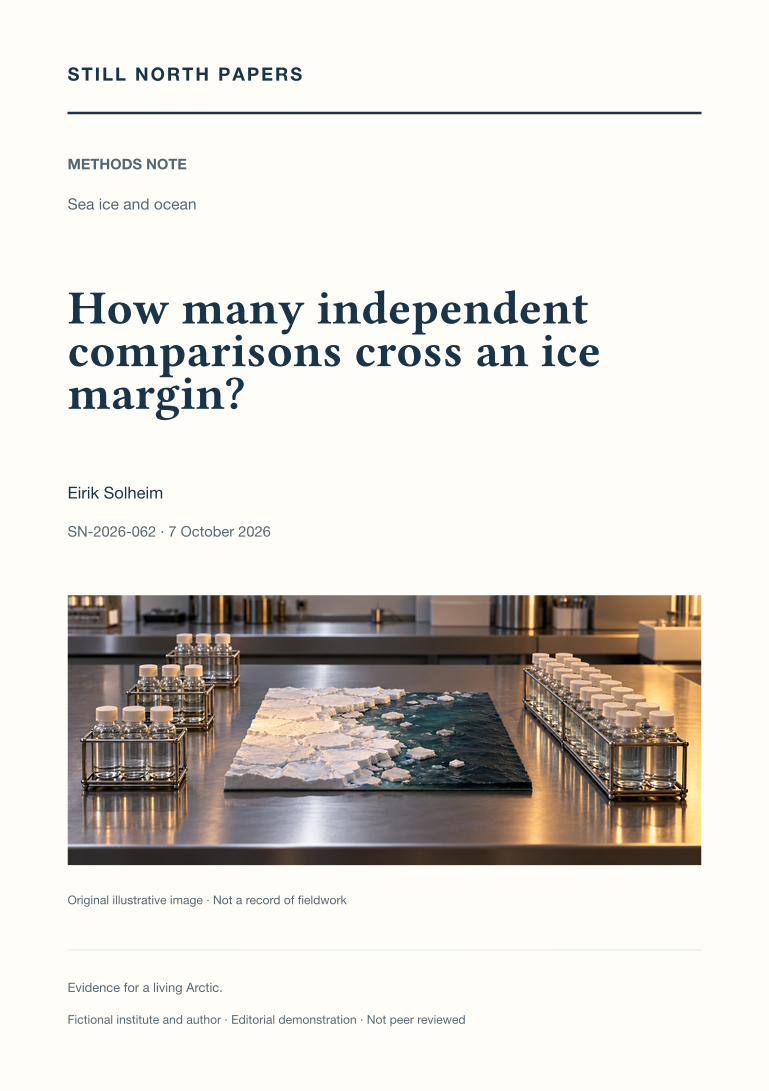
How many independent comparisons cross an ice margin?
An ice-margin transect can contain many samples but only one independent environmental contrast. This methods note combines published principles of replication with Arctic bloom observations to examine how a limited station budget can support a defensible regional question. A hypothetical allocation of eighteen casts compares a dense single crossing with three repeated crossings, distinguishing technical replication, local gradient resolution, and variation among contrasts. The note also separates distance from the present ice edge from time since local retreat and examines sampling order, depth integration, water masses, and access-related missingness. It offers neither a cruise plan nor a power calculation. The useful conclusion is an explicitly bounded association whose claimed replication matches the field design rather than the number of bottles collected.
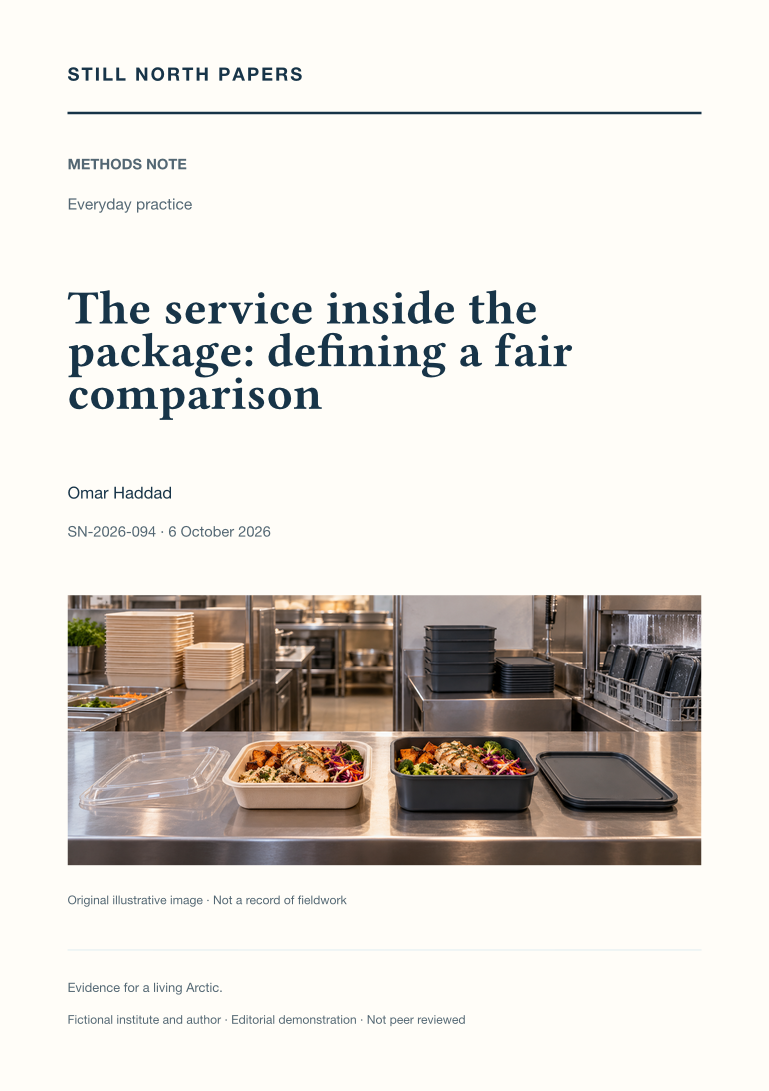
The service inside the package: defining a fair comparison
Packaging comparisons become misleading when they count empty objects rather than equivalent deliveries. This methods note develops a functional-unit procedure for a small food service, drawing on the GHG Protocol Product Standard, the European Commission’s Environmental Footprint recommendation, and the Environment Agency’s original carrier-bag assessment. A hypothetical returnable-container case distinguishes completed meals, realised reuse, delayed returns, washing, replacement lids, collection journeys, and food loss. The analysis explains why consistent boundaries and evidence of displacement matter before environmental rankings are attempted. It also keeps accessibility and food safety outside any simplistic carbon score. No packaging footprints or savings are estimated. The proposed decision record identifies which operational observations and supplier information would be needed to support a defensible local comparison.

Cite the release, not the latest link
A persistent dataset address can resolve successfully while no longer providing the evidence used in a published calculation. This methods note compares FORCE11 citation principles, DataCite versioning guidance, and Research Data Alliance recommendations for evolving data. A fictional index revision separates corrected observations from expanded coverage and demonstrates why collection identifiers, release identifiers, subsets, and analysis outputs answer different questions. The discussion examines immutable releases, timestamped queries, stable sorting, checksums, and persistent landing pages without presenting any one repository design as mandatory. It distinguishes exact reproduction from scientific robustness and explains why reproducibility does not override legitimate restrictions. The resulting recommendation is a compact citation backed by recoverable authorised evidence and an inspectable method, with explicit limits when retrieval becomes impossible.
Estimating shrub area from a vegetation confusion matrix
Mapped shrub area and estimated shrub area are different quantities when classification errors are asymmetric. This methods note synthesises area-assessment guidance, Arctic vegetation-map documentation, and image-quality information. It separates class definitions, spatial support, sampling design, and reference interpretation before introducing a fictional stratified confusion matrix. The worked calculation shows how an apparently accurate map can omit a substantial share of shrub vegetation and how design weights alter area and accuracy estimates. The note addresses rare classes, clustered validation, uncertain reference labels, positional error, and change-map interpretation. It does not evaluate an actual Arctic map or produce corrected pixels. Its reporting implication is to retain mapped totals, sample-based area estimates, weighted error matrices, and uncertainty separately, so users can distinguish a regional area claim from confidence in any individual location.
Comparing passive-microwave ice algorithms without a false winner
Passive-microwave sea-ice products can disagree because their retrievals, calibration, filtering, and surface assumptions differ. This methods note synthesises three published intercomparisons to show how a fair quantitative evaluation separates bias, scatter, spatial cancellation, and threshold effects. Invented matched-footprint examples demonstrate why zero average error can coexist with local errors, why clipping at full concentration can conceal retrieval bias, and why a small concentration difference can produce a large extent difference. The analysis distinguishes concentration from net ice surface fraction and treats summer melt as a separate evaluation problem. It does not rank current operational releases or rerun the cited studies. Its practical outcome is a conditional product comparison tied to a stated quantity, season, reference dataset, and downstream decision.

Publishing community maps without exposing lives
Public release changes what a community map can reveal, even when names are removed. This methods note compares NIST de-identification guidance with Indigenous data-governance and Canadian research ethics sources to examine identification, collective exposure, and inference from omissions. A wholly fictional seasonal-observation case contrasts exact points, displaced points, broad zones, and a non-spatial account. It shows why record counts, contributor counts, and complete release packages require separate scrutiny, and why suppressing one cell may not prevent reconstruction. The analysis favours a purpose-led, authorised derivative rather than automatic export of the source map. It provides neither an anonymisation guarantee nor a universal Indigenous checklist, and identifies changing linkage opportunities, review capacity, and irreversible distribution as important limits.
Designing event sampling for annual suspended-sediment load
Monthly sediment sampling can span an entire year while missing its dominant transport events. This methods note uses US Geological Survey estimation guidance and an empirical river investigation to examine the design of annual suspended-load monitoring. A fictional year demonstrates how two event days can dominate the total and why continuous discharge alone cannot recover their unmeasured concentrations. The discussion considers event limbs, routine and triggered samples, cross-section representativeness, turbidity calibration, sensor failures, and validation that withholds whole events. It distinguishes model intervals from uncertainty caused by unobserved conditions and changing sediment sources. No actual river load or Arctic conversion factor is estimated. The practical recommendation is a coverage account tied to the annual result, allowing subsequent sampling to address the largest demonstrated blind spots rather than simply filling the calendar.