

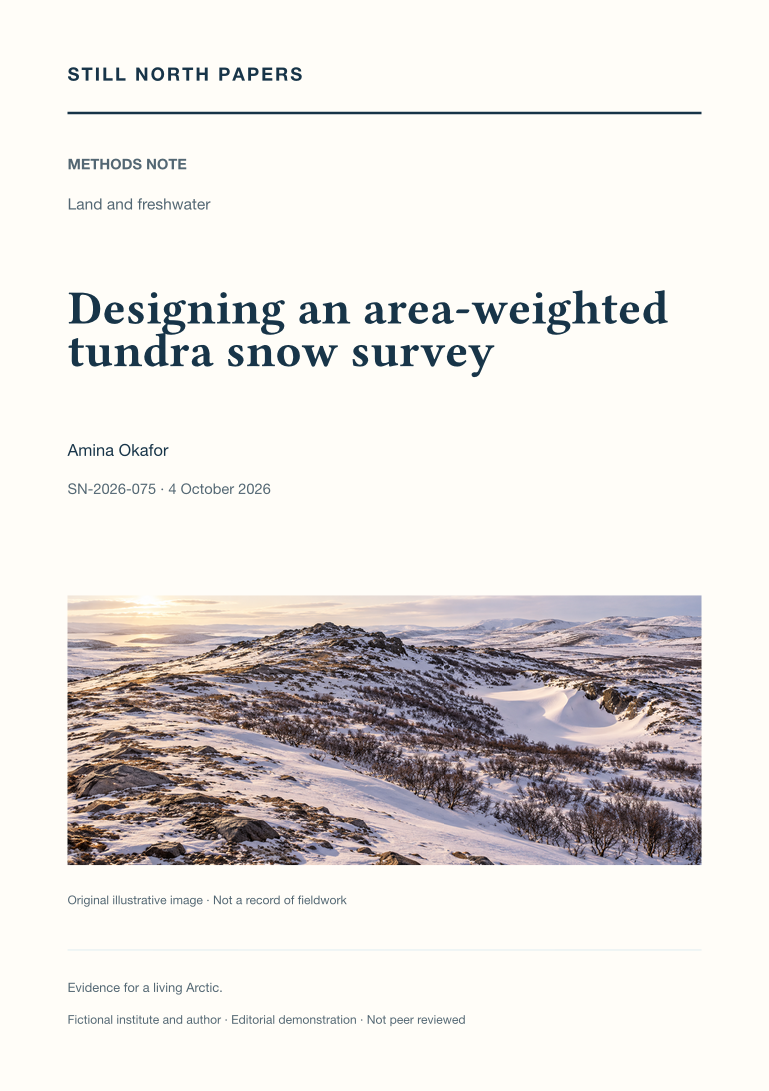
Designing an area-weighted tundra snow survey
Accurate snow cores do not guarantee an area-representative catchment estimate. This methods note synthesises snow-sampling evidence, Arctic snow reporting, and uncertainty principles to examine stratification and area weighting for tundra snow water equivalent. A fictional three-stratum catchment demonstrates how equal sample allocation can overrepresent deep drifts, while a small drift area can still contribute substantially to stored water. The note distinguishes weighting from representative selection and follows sampling, map-area, spatial-dependence, and survey-timing uncertainties. It considers how the next sample can improve the target estimate rather than merely enlarge a convenient route. No operational travel advice or real snow assessment is provided. The proposed reporting account includes terrain shares, class means, selection design, missing coverage, and the date represented, without treating storage as a runoff forecast.
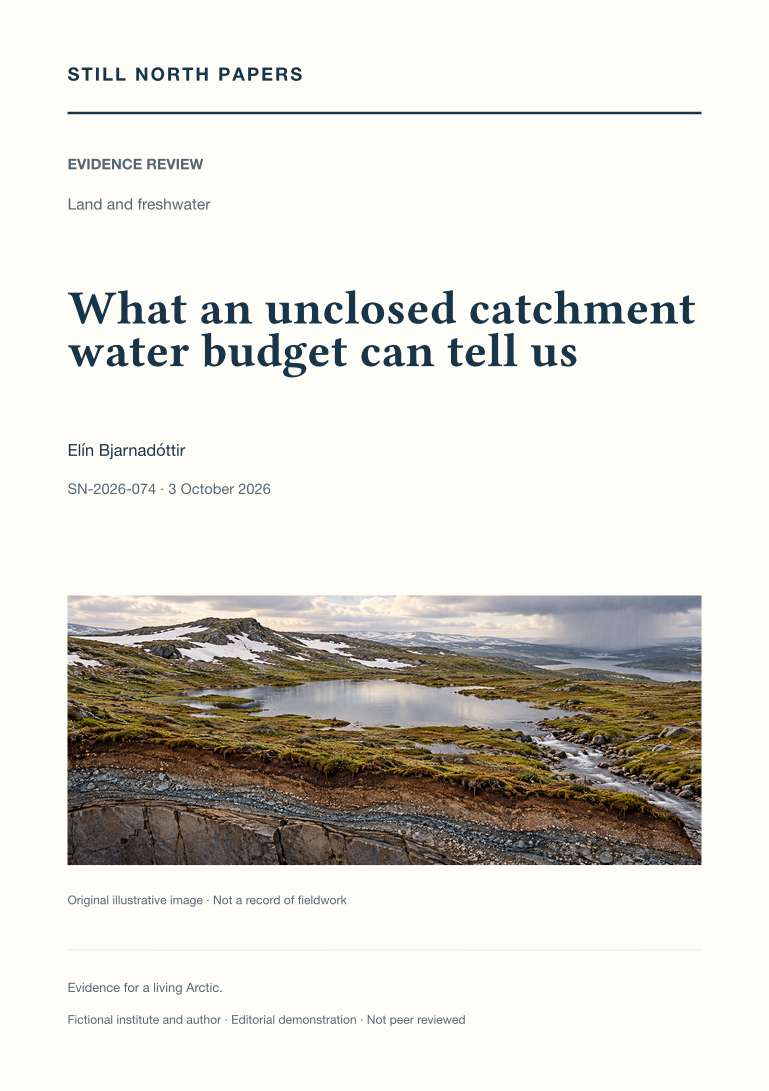
What an unclosed catchment water budget can tell us
An imbalance in a catchment water budget does not identify a missing pathway, and exact closure does not validate every component. This evidence review synthesises two multi-basin closure studies and measurement-uncertainty guidance to develop a diagnostic approach for northern catchments. It examines boundary definitions, compatible units and periods, snow carryover, storage, and dependence between products. A fictional annual account shows why a residual can be small relative to combined uncertainty and why replacing an independent evapotranspiration estimate with a remainder is not validation. Seasonal residual patterns and targeted independent observations are considered as ways to discriminate explanations. The review supplies no universal closure threshold and performs no local assessment. Its conclusion is that retaining the residual and component histories makes a budget more informative than forcing an apparently complete account.
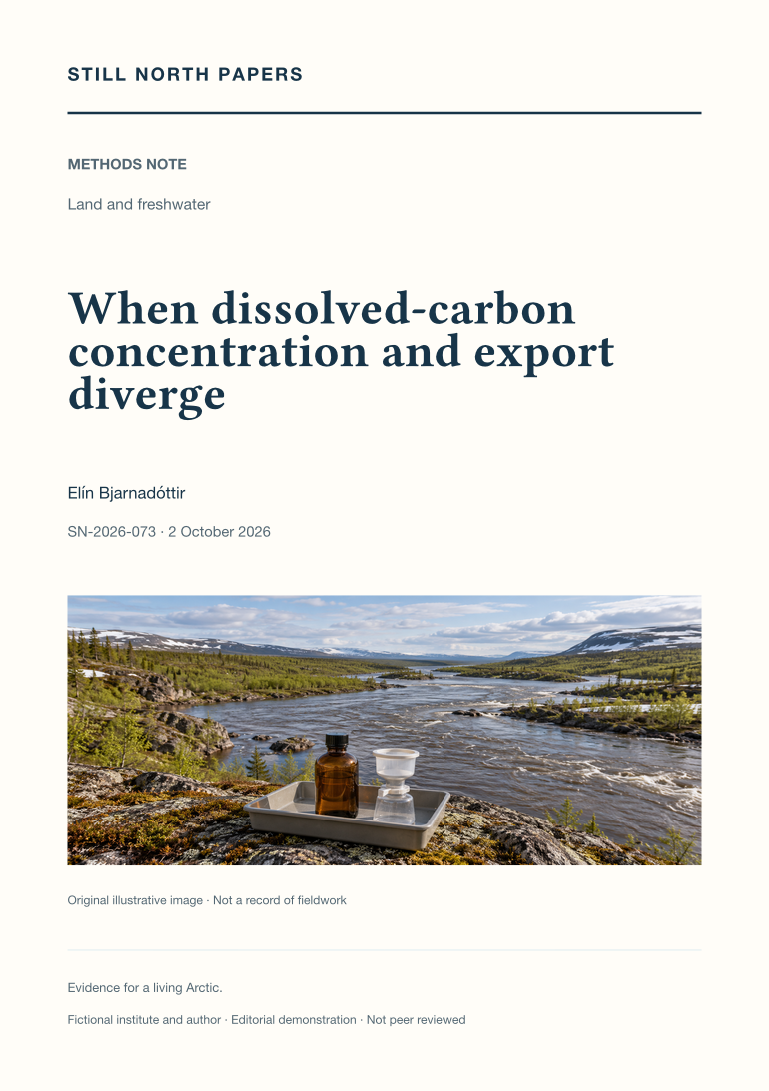
When dissolved-carbon concentration and export diverge
Dissolved organic carbon concentration and annual river export can move in opposite directions because transport depends on water volume and the timing of chemistry. This methods note combines published Arctic river sampling evidence, load-estimation guidance, and uncertainty principles. It defines the dissolved fraction and river-section boundary, explains concentration–discharge covariance, and distinguishes sampled, time-weighted, and flow-weighted summaries. Fictional calculations demonstrate both the bias from multiplying separate means and a year with declining concentration but increasing export. The note examines seasonal coverage, station alignment, calibration limits, and correlated prediction errors. It does not estimate Arctic carbon emissions or identify the age and fate of exported carbon. Its practical implication is to publish water volume, carbon mass, sampling support, and reconstruction assumptions together before interpreting an annual change.
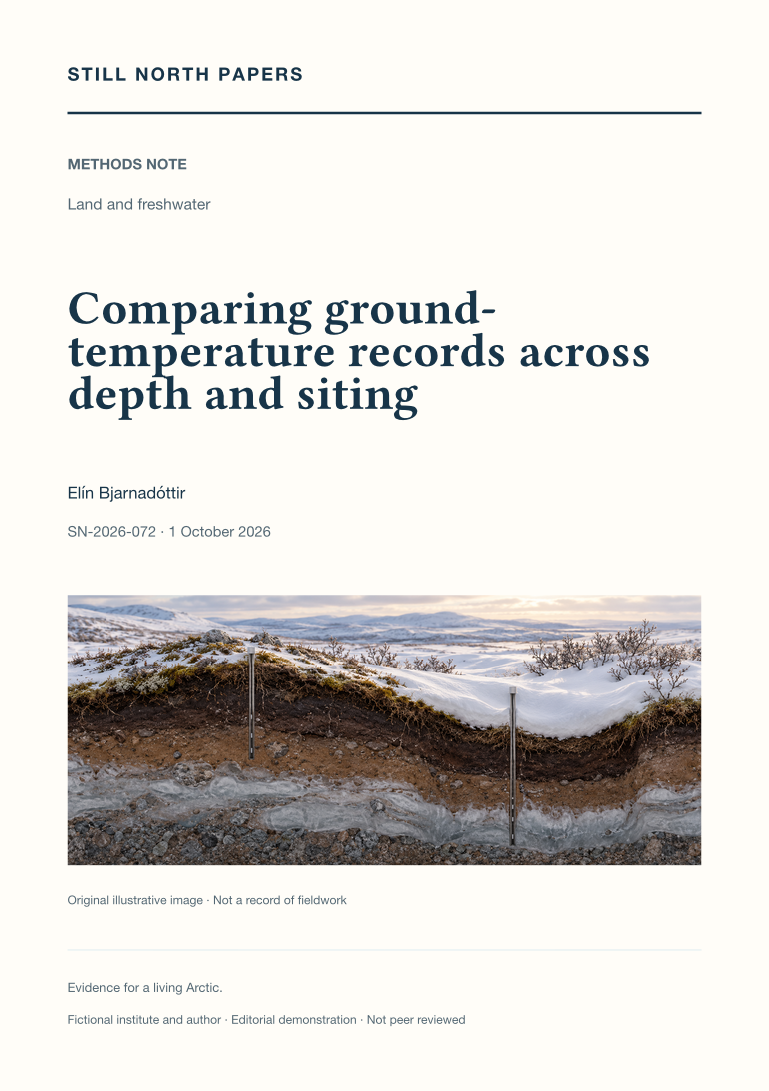
Comparing ground-temperature records across depth and siting
Ground-temperature records can acquire apparent changes when sensors move, depths change, or surface conditions differ. This methods note synthesises a documented Arctic borehole dataset, permafrost-network metadata, and measurement-uncertainty guidance to examine when records are comparable. It distinguishes instrumental transfer from relocation between environments and explains why depth changes both seasonal sensitivity and response time. Fictional worked cases show how joining two individually valid records can introduce a step, and how depth uncertainty enters a temperature budget. The note recommends preserving comparable record segments, overlap evidence, and adjustment assumptions rather than forcing visual continuity. It estimates no regional trend and provides no universal depth correction or minimum overlap. Its contribution is a practical framework for keeping continuity of meaning visible when an observing system changes.
An evidence session with room for a better question
An effective school or community evidence session can concentrate on one answerable Arctic question rather than an exhaustive presentation. This essay proposes a session around the difference between a record-low winter sea-ice maximum and a summer minimum, using NOAA's resource kit and sea-ice chapter. Participants inspect an accessible figure, identify observations, check definitions, and test a claim before writing a supported finding, a limit, and a next question. Daily and monthly statistics provide a second opportunity to practise reading captions and tables. The discussion separates factual corrections from value disagreements and uses the National Inuit Strategy on Research to respect attributed authority without asking individuals to represent a people. Its intended outcome is traceable reasoning and continued questions, not pledges, recall, or manufactured agreement.
Read the Arctic Report Card beyond the headlines
Annual Arctic headlines describe different quantities rather than a single environmental score. This essay follows claims through NOAA's 2025 Report Card chapters to show how definitions, units, periods, baselines, and record lengths constrain interpretation. Sea-ice extent is distinguished from thickness and age, while daily minima and monthly averages illustrate how a correct value can be paired with an incorrect ranking. Different calendars underlie the temperature and Greenland annual assessments. Apparent contrasts, including a record-low winter maximum without a record-low summer minimum, invite explanation rather than selective quotation. The observing-network chapter also has a bounded assessment population, not universal coverage. A concise reading note preserves each finding with its place, period, method, important limit, and chapter before the headline is shared.
Say what is uncertain, precisely
Useful uncertainty communication identifies what is uncertain and what that changes. This essay separates observed quantities, their uncertainty, explanations, and policy decisions rather than allowing a vague caveat to weaken every statement. IPCC guidance supplies the distinction between confidence based on evidence and agreement and likelihood expressed as quantified uncertainty. NOAA's Greenland assessment illustrates the need to preserve measurement periods and context when comparing annual and partial-year estimates, and to distinguish reduced loss from recovery. The discussion also explains why shaded bands and plus-or-minus notation require definitions. Bounded claims about sampled places, seasons, or detections are more informative than blanket reassurance or dismissal. A decision still requires explicit consideration of consequences, affected people, and review triggers; an uncertainty interval cannot choose the policy.
A research question before a sensor
Choosing a sensor before defining the research question can produce precise data that do not answer the original concern. This essay works backwards from a hypothetical river-colour problem to distinguish community concern, a researchable comparison, and the decision a limited study might inform. It examines competing explanations, representative locations, event timing, existing records, and plans for unsafe access or missing samples. The National Inuit Strategy on Research supplies governance context, and NOAA's network assessment illustrates why more observations at an unsuitable location do not repair every gap. Equipment selection follows the required quantity, discrimination, and coverage, with maintenance and stewardship included. Rehearsing a possible result using explicitly invented values tests whether the proposed observations could distinguish explanations without predetermining the finding.
When results make the journey home
Returning research results requires an understandable answer and continuing responsibility, not just a public download link. This essay uses a hypothetical water study to show why a local question must remain visible alongside academic interpretations and why limited samples cannot imply a comprehensive safety assessment. The National Inuit Strategy on Research places usefulness within governance and authority, while W3C guidance informs layered explanations, charts, tables, and accessible alternatives. Formats, language, timing, and correction routes should be agreed before collection, with private ways to raise questions or errors. The discussion distinguishes review from demands for favourable conclusions and protects participation from assumed recording permission. Dated summaries, retained authoritative records, and stewardship beyond the final event help keep the answer reachable after a project ends.
Open data, whose authority?
Easy downloading does not establish authority to reuse a dataset responsibly. This essay reads the National Inuit Strategy on Research as connected commitments to governance, ethics, funding, data control, and capacity, not a transferable permission checklist. A hypothetical reuse of locally shared travel knowledge shows how combining or opening information can introduce risks even when names are removed. TCPS 2 Chapter 9 adds policy context while explicitly not replacing Indigenous peoples' own guidance. The discussion connects agreed authority to repository permissions, review processes, staff handover, and differentiated release terms. It also distinguishes public availability from unrestricted ethical reuse. Useful outcomes may include locally governed information or a decision not to disclose, but those outcomes must be defined with the relevant authorities rather than claimed by outside institutions.
Consent is a conversation, not a form
Consent requires an understandable, voluntary, and continuing choice, not merely a signed form. Using a hypothetical interview about winter conditions, this essay separates participation from permission to publish recordings, locations, or quotations. Canada's TCPS 2 consent guidance informs discussion of explanation, power relationships, recruitment, compensation, and meaningful refusal, while remaining a specific policy rather than a universal legal rule. The National Inuit Strategy on Research helps distinguish individual consent, institutional approval, and collective authority without prescribing local arrangements. Changed projects and new uses may require renewed permission, and withdrawal limits must be explained before participation. The practical conclusion is operational: clear responsibilities, private records, and usable routes to pause, revise, or decline should continue after documentation has been completed.
A reproducible chart starts before the chart
A chart's source link does not preserve the decisions that produced its values. This essay explains how a reproducible public graphic begins with a defined question, comparable quantities, and an explicit analysis record. NOAA's Arctic temperature chapter illustrates the importance of geographical coverage, water-year timing, baselines, and distinct input products. A simplified baseline example separates a changed reference from a changed observation, while noting that other processing choices can also differ. The proposed compact recipe retains input versions, retrieval dates, selections, weighting, filters, completeness rules, and transformation order. Climate and Forecast history conventions support this record but do not replace explanation. Accessible tables, labelled uncertainty, and distinctions between measurements and estimates help readers recover the calculation even when they disagree with its interpretation.
Maintenance is the next observation
A durable observation record depends on funded maintenance, skilled people, and governed stewardship as much as on an initial sensor purchase. This essay uses a fictional station budget to identify omitted costs such as calibration, communications, processing, handover, and removal. NOAA's network assessment provides evidence for the wider importance of expertise, infrastructure, and product continuity, without serving as a live account of programme finances. Missing seasons and lost instrument overlap cannot simply be restored by buying replacement hardware. The National Inuit Strategy on Research also informs attention to priorities, capacity, and budget authority. The discussion recommends comparing contributions and dependencies openly, including responsible closure where justified. Support should sustain usable evidence, not purchase predetermined conclusions, exclusive knowledge, or unsupported claims of deployment success.
The calibration record behind a trusted number
A calibration certificate characterises response under stated conditions, not the fitness of every later field value. This essay draws on NIST's traceability policy to distinguish documented reference chains from reassuring equipment labels, and calibration from adjustment. Hypothetical deployment examples show how exposure, depth, and installation can undermine representativeness even when a sensor responds correctly. Field checks, post-deployment changes, and shared biases require explicit limits rather than assumed histories of gradual drift. NOAA's observing-network assessment supplies context for transitions between instruments and the value of comparable overlap. The practical recommendation is to preserve raw values, reference details, conditions, uncertainty contributions, correction parameters, and method versions. A trusted number is one whose measurement and correction history a future researcher can reconstruct for its intended use.
Missing observations are not zeroes
A missing observation, a usable recording with no detections, and a signal obscured by noise support different conclusions. This essay uses hypothetical acoustic records to distinguish counts from effort-adjusted rates and to show why downtime must not become successful listening. It draws on Climate and Forecast conventions to discuss missing-value codes and separate quality flags, including the care needed for values below reporting limits. NOAA's observing-network assessment supplies context for uneven seasonal and spatial coverage. When gaps depend on weather or access, the remaining record may not represent the full conditions of interest. The practical recommendation is to preserve reasons for absence, coverage rules, method changes, and visible chart gaps, while distinguishing estimated values from measurements and never treating zero detections as proof of animal absence.
Metadata that outlives an instrument
Measurements can survive while the context needed to interpret them disappears. This essay identifies metadata that preserves comparability, reproducibility, and permission to use a record. A fictional temperature-logger replacement illustrates how altered sampling intervals can change an analysis unless deployment and aggregation choices remain explicit. Climate and Forecast conventions provide an existing language for quantities, coordinates, units, and history, complemented by separate deployment and processing logs. NOAA's observing-network assessment supplies wider context for sensor transitions and recalibration. The discussion recommends retaining original observations, versioned products, documented corrections, access conditions, and an institutional stewardship role. Complete documentation is not equated with unrestricted publication. A practical handover exercise asks whether an unfamiliar reader can explain one published value using the archive alone, without relying on someone's memory.

A consultation response someone can act on
A useful consultation response connects relevant knowledge to a decision that remains open. This practice essay explains how to locate the proposal version, responsible body, submission rules, and actual scope before concentrating on the part that affects the respondent. A hypothetical community-building entrance illustrates how a point can identify a drawing, describe an effect, state its evidential basis, and request a specific assessment or amendment. Cabinet Office principles provide context, not a universal rulebook for local processes. The discussion also covers authorised representation, publication notices, privacy, accessible submission routes, and honest treatment of group disagreement. Keeping the final response and acknowledgement enables later comparison with the decision record. The aim is an answerable request, not an invented expert identity or a claim that consultation necessarily operates as a vote.

Keep the question small when you disagree
Climate disagreements become more tractable when observations, explanations, and proposed responses are treated as distinct questions. This practice essay offers a source-reading approach rather than a promise of persuasion. It recommends agreeing a narrow claim, checking original chart definitions, and comparing geographical coverage, periods, units, and baselines before treating two graphics as contradictory. Royal Society material supplies the distinction between established physical understanding and remaining questions about regional effects, feedbacks, and future emissions. Personal experience can illuminate local impacts without measuring a global trend, while global evidence cannot resolve every access concern. The discussion keeps fairness and policy trade-offs visible, acknowledges boundaries around unsafe exchanges, and concludes that a careful shared question can improve one decision without requiring agreement on everything.
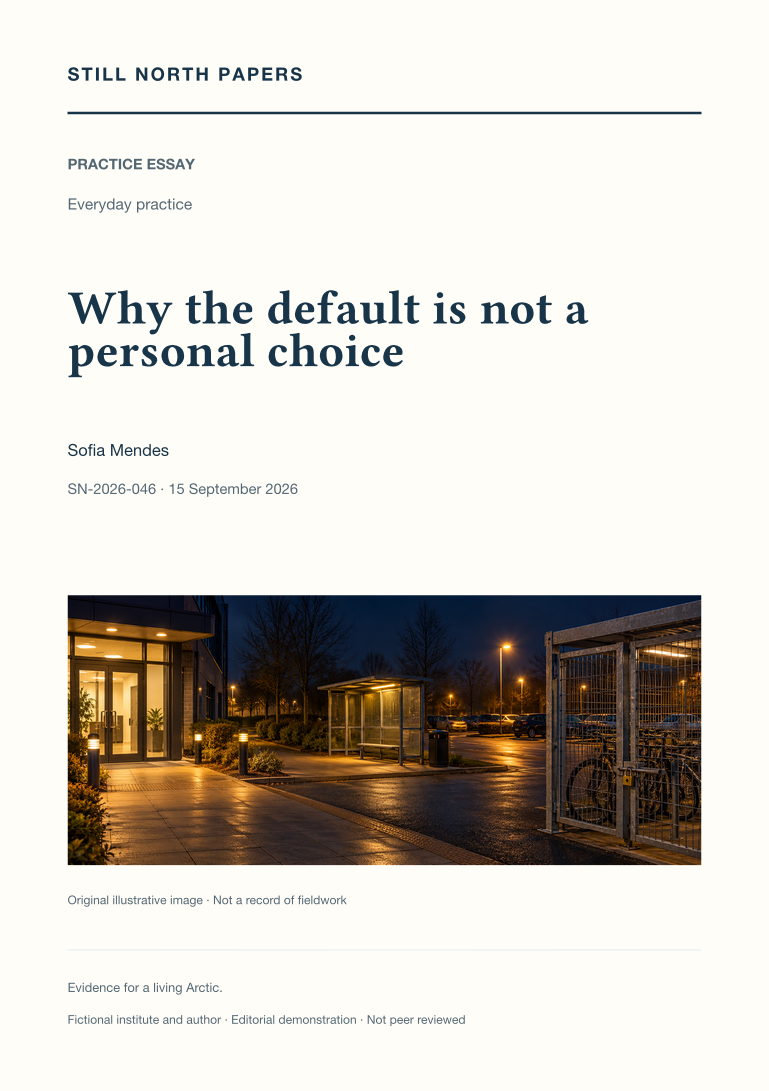
Why the default is not a personal choice
A lower-impact option is not a genuine choice if its surrounding services make it unusable. Beginning with two hypothetical late-shift journeys, this practice essay uses the IPCC's service-based account of demand to distinguish a need from the object or fuel currently meeting it. Schedules, infrastructure, expenses rules, and access arrangements can establish a default before an individual acts. A short friction map identifies the need, available options, obstacle, and institution able to change it. The discussion stresses private exception routes and attention to who bears extra time or cost. It also separates service uptake from demonstrated emissions reductions. Its conclusion places individual experience and institutional change together, directing requests towards the specific arrangements that responsible organisations can actually alter.

Enough food for the room
Community catering can provide enough food without treating an overflowing display as the measure of generosity. This practice essay begins with a hypothetical workshop to distinguish a promised meal from refreshments and an attendance range from a single forecast. It connects dietary information, flexible portions, refrigeration, competent helpers, and available equipment before proposing a menu. Official community-event guidance anchors safety and allergen responsibilities while leaving jurisdiction-specific advice to the relevant authority. Planned reserves and controlled replenishment differ from food left on display, and surplus categories need different handling at the end. The discussion concludes that quantities, safe redistribution, record-keeping, and clearing-up labour should be planned together. Avoiding waste cannot justify uncertain food, inadequate portions, or an unsafe workload for volunteers.