

After the click: testing whether evidence was understood
Clicks and reading time describe exposure but do not establish comprehension, retention, or transfer. This methods note develops an evaluation for two hypothetical, accurate versions of a climate-evidence explainer. It draws on van der Bles and colleagues’ uncertainty-communication experiments, Karpicke and Blunt’s learning experiments, and the Magenta Book. Proposed tasks examine baselines, aggregate scale, and uncertainty while keeping trust, confidence, and policy agreement separate from learning. The analysis addresses audience selection, attrition, assessment-induced learning, delayed follow-up, accessible questions, and proportionate privacy. No reader data or communication effects are reported. Its practical implication is to choose evidence measures that test a defined capability and preserve disagreement over values, rather than treating platform engagement as proof that public understanding improved.
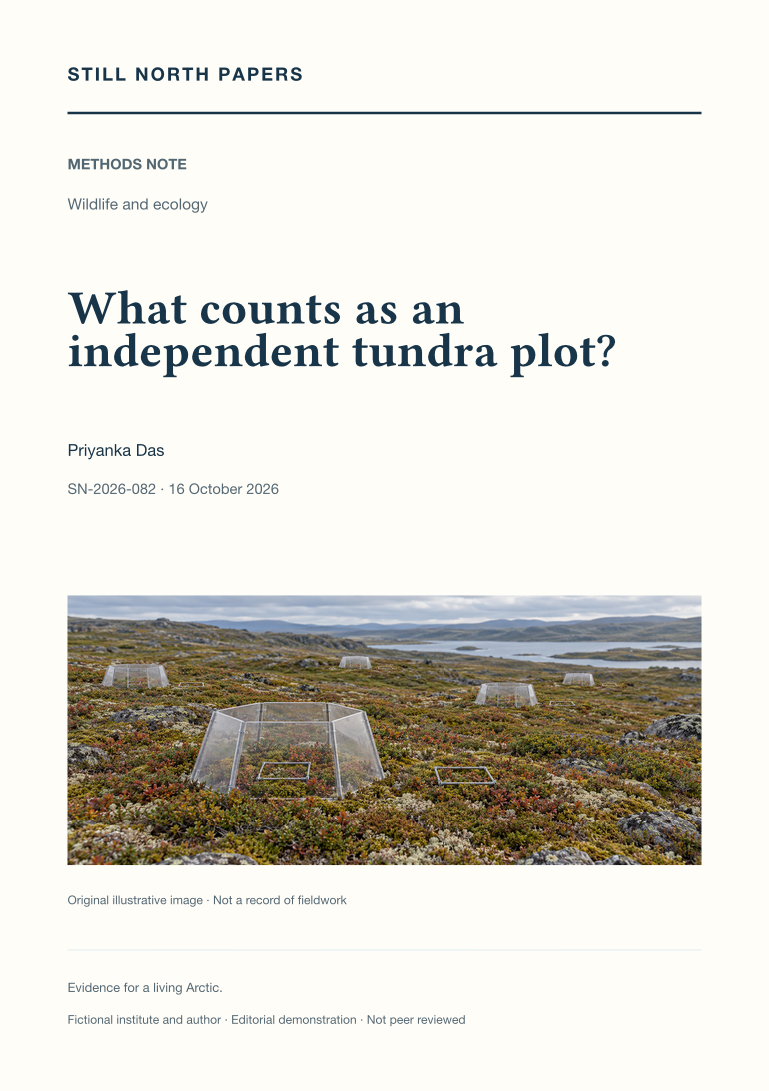
What counts as an independent tundra plot?
Large numbers of tundra measurements need not provide large numbers of independent treatment tests. This methods note synthesises experimental-design principles, International Tundra Experiment guidance, and clustered spatial-sampling methods. It distinguishes measurement, quadrat, plot, block, and site, and separates spatial autocorrelation from the more fundamental problem of unreplicated treatment assignment. Fictional designs contrast intensive subsampling of one treated patch with replicated paired blocks, showing which level supports the treatment estimate. The discussion considers blocking, environmental side effects, hierarchical analysis, design-respecting resampling, regional generalisation, and the allocation of effort between breadth and detail. It offers no universal spacing or minimum replicate count. Its conclusion is a reporting practice that states sample sizes at each consequential level and matches every inferential claim to the independence the actual design supports.
Look for a common driver before linking ocean series
Strong correlation and a plausible lead can arise when two ocean records share a driver rather than directly influence one another. This methods note combines Earth-system causal-inference research with studies of nonlinear ecological dynamics and autocorrelated fish-environment data. An invented two-regime calculation produces a correlation of approximately 0.94 despite zero within-regime association and no constructed direct effect. The analysis then examines lagged common forcing, sampling and smoothing, seasonal transformations, adjustment choices, and the assumptions behind advanced causal methods. It attributes no actual ocean event and does not claim that conditioning alone establishes causation. Its practical outcome is a sequence of rival physical explanations and discriminating observations, allowing unresolved associations to guide a better next measurement instead of an overstated causal story.

What a policy pilot can earn permission to scale
A pilot can establish delivery feasibility without resolving effectiveness, additionality, or performance at scale. This methods note develops a reading procedure for a hypothetical repair-voucher programme using the Magenta Book, the CONSORT pilot-trial extension, and Deaton and Cartwright’s methodological analysis. It distinguishes invitation, enrolment, use, repair completion, and sustained service, and explains selection, intention-to-treat comparisons, missing data, uncertainty, and transportability. The fictional planning case contains no completed trial or measured outcomes. Scaling questions include repairer capacity, upfront-payment barriers, changing costs, and different participant populations. No policy saving or climate effect is estimated. The practical implication is to match progression decisions to the pilot’s learning objective, pre-specified criteria, ethical constraints, and the supporting conditions a larger programme would require.
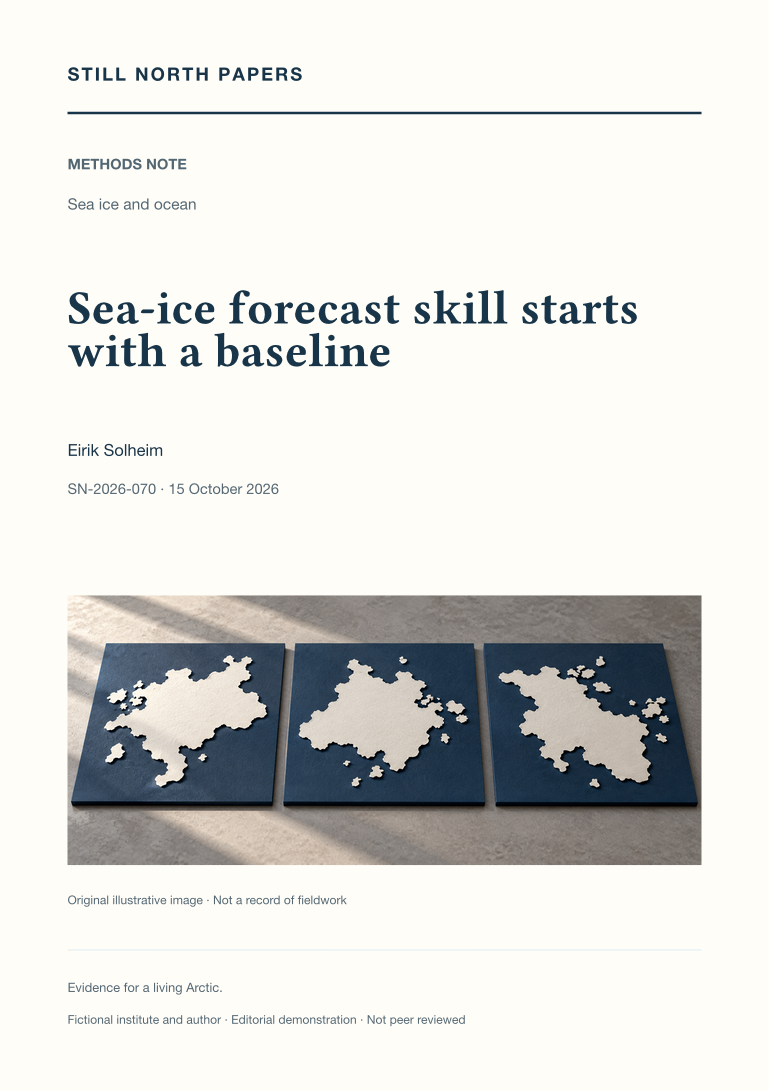
Sea-ice forecast skill starts with a baseline
Forecast accuracy does not establish added information unless it is compared with an explicit alternative. This methods note draws on primary ice-edge verification and subseasonal prediction studies to define a fair comparison among a model, climatology, and persistence-based forecasts. A hypothetical Brier-score calculation shows how a model can be skilful against one baseline and unskilful against another. A spatial example explains why correct total extent can coexist with a misplaced ice edge. The note examines issue-time information boundaries, changing climatology, calibration, dependence, and observation uncertainty without evaluating an operational system. Its practical conclusion is a conditional skill statement naming the target, lead, dates, region, reference observations, and baseline, rather than treating a high percentage of correct outcomes as sufficient evidence of usefulness.

What would have happened without the campaign?
A favourable decision after collective action is not automatically an effect caused by that action. This methods note develops a counterfactual evaluation for a fictional workplace transport coalition, drawing on the Magenta Book, the GHG Protocol Policy and Action Standard, and the IPCC demand-side assessment. A pre-existing employer plan illustrates bounded contribution rather than exclusive credit, while invented arrival counts expose the assumptions behind before-and-after and comparison-group arithmetic. The analysis distinguishes mobilisation, decisions, implementation, sustained operation, and downstream climate effects. Participant protection and ethical constraints remain part of the design. No campaign result or emissions saving is claimed. The proposed approach supports honest learning from shared influence, partial gains, and unresolved demands without converting signatures into unsupported carbon totals.

Calibrating soil-moisture probes for organic tundra horizons
Dielectric soil-moisture probes convert a material-dependent electrical response into a water-content estimate. This methods note synthesises organic-soil calibration experiments, freeze–thaw dielectric research, and uncertainty guidance to examine transfer from mineral to organic horizons. A fictional core calculation separates gravimetric and volumetric content and shows how drying shrinkage can alter the reference value before a sensor equation is fitted. The discussion considers calibration domains, independent validation, sensing support, saturation, installation, raw-output preservation, and the difference between liquid-water response and total water during freezing. It recommends no universal equation, drying procedure, or ecological threshold. The practical implication is to match calibration and phase-state interpretation to the intended inference, and to report a narrower relative signal when absolute water content remains insufficiently constrained.
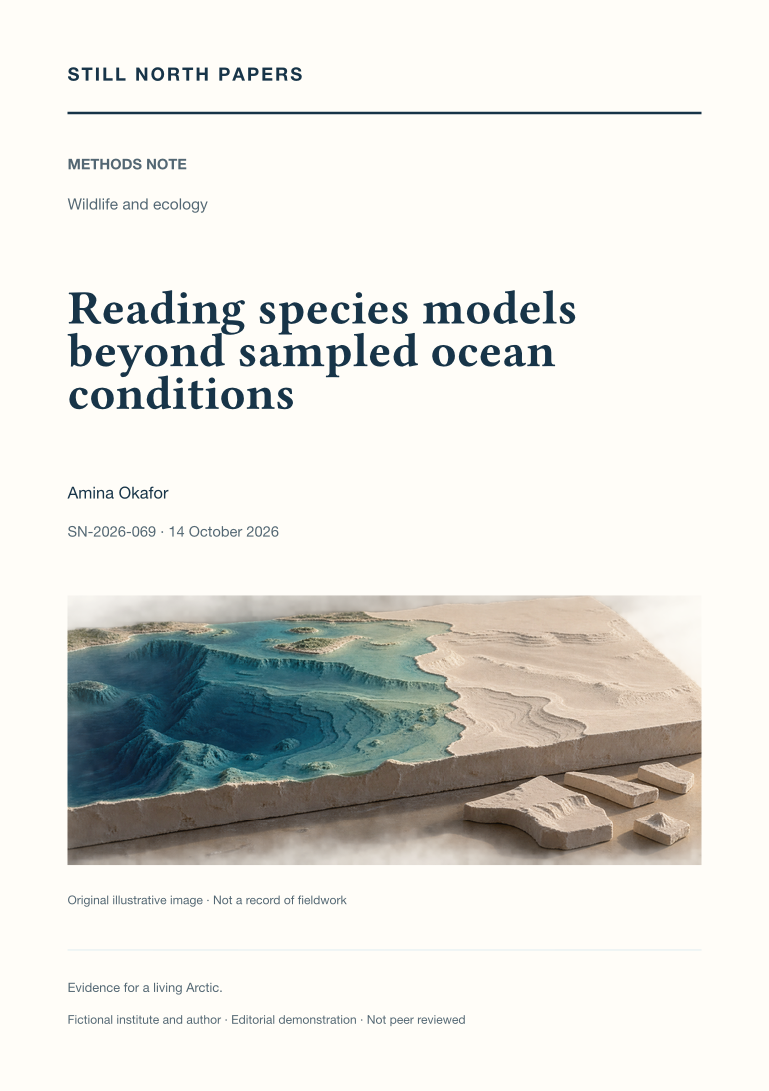
Reading species models beyond sampled ocean conditions
A complete species-distribution map can conceal large gaps in environmental support. This methods note uses published environmental-novelty, transferability, and structured-validation research to distinguish interpolation from extrapolation in ocean applications. A hypothetical temperature-salinity example separates a new predictor range from a novel combination that lies within every individual range. Further decision cases examine structural disagreement beyond training conditions, clamping, observation bias, and validation splits matched to intended deployment. No real species model is fitted or range shift predicted, and terrestrial or freshwater case-study results are not imported as marine performance rankings. The practical output is a prediction accompanied by its evidence boundary, uncertainty, and sensitivity, making explicit where additional surveys would be more informative than an unqualified probability surface.

A cleaner portfolio is not yet a financing effect
Lower attributed portfolio emissions do not by themselves demonstrate lower emissions caused by investor action. This methods note separates accounting exposure, investee operations, new financing, and investor contribution using PCAF’s financed-emissions standard, GHG Protocol guidance, and Pástor and colleagues’ original equilibrium model. A fully fictional corporate-bond example shows how a valuation denominator can change reported attribution while stipulated physical emissions remain constant. The analysis also distinguishes secondary trading, additional finance, engagement activity, and causal evidence, and keeps avoided emissions separate from inventories. It offers no fund recommendation, investment-performance claim, or real-world saving. Its practical contribution is a due-diligence sequence connecting a reported improvement to its accounting drivers, proposed mechanism, counterfactual, and evidential limits.

Rare events and the denominator of a flag
High sensitivity does not establish that most threshold flags are correct. This educational methods note uses a synthetic waveform archive to distinguish sensitivity, false-positive rate, precision, false-alarm ratio, and overall accuracy. Natural-frequency tables demonstrate how a rare target can yield more incorrect than correct flags, while a second population shows how precision changes with the base rate even when conditional rates are held fixed. A stricter invented threshold makes the retrieval and review-burden trade-off explicit. Primary reasoning and classifier-evaluation studies accompany forecast-verification definitions. The note also addresses event units, correlated windows, threshold tuning, and human review. It validates no detector, recommends no operational threshold, and explicitly excludes medical, navigation, emergency, and other safety applications.
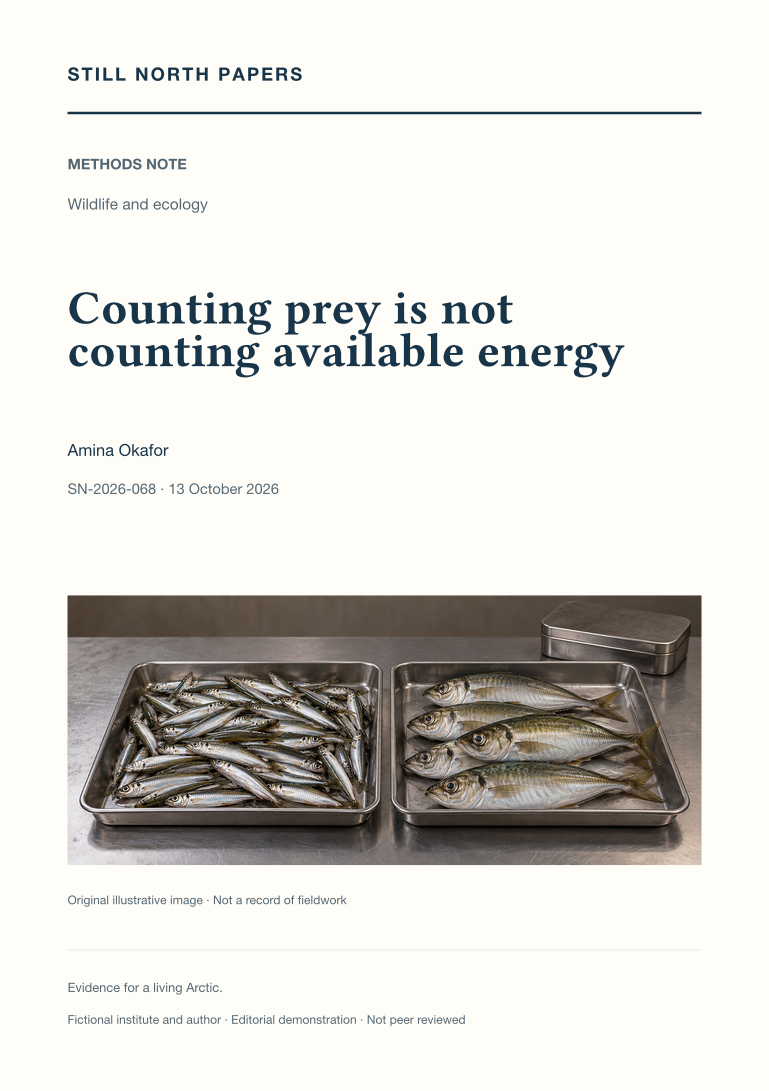
Counting prey is not counting available energy
Prey counts, biomass, potential energy, and predator benefit need not change in the same direction. This methods note combines forage-fish composition measurements, comparative cetacean evidence, and an ontogenetic consumption analysis to clarify the conversion among those quantities. Invented samples demonstrate a forty-percent decline in count alongside an eighty-percent increase in calculated energy, while additional examples expose wet-versus-dry-mass errors and conditional assimilation assumptions. The cited studies span subarctic and other marine systems; their fitted values are not treated as Arctic constants. The note does not estimate actual ingestion or predator fitness. It argues for retaining counts and biomass alongside energetic conversions, then asking whether a specified consumer can capture the relevant prey, at an appropriate season and life stage, for a useful net return.
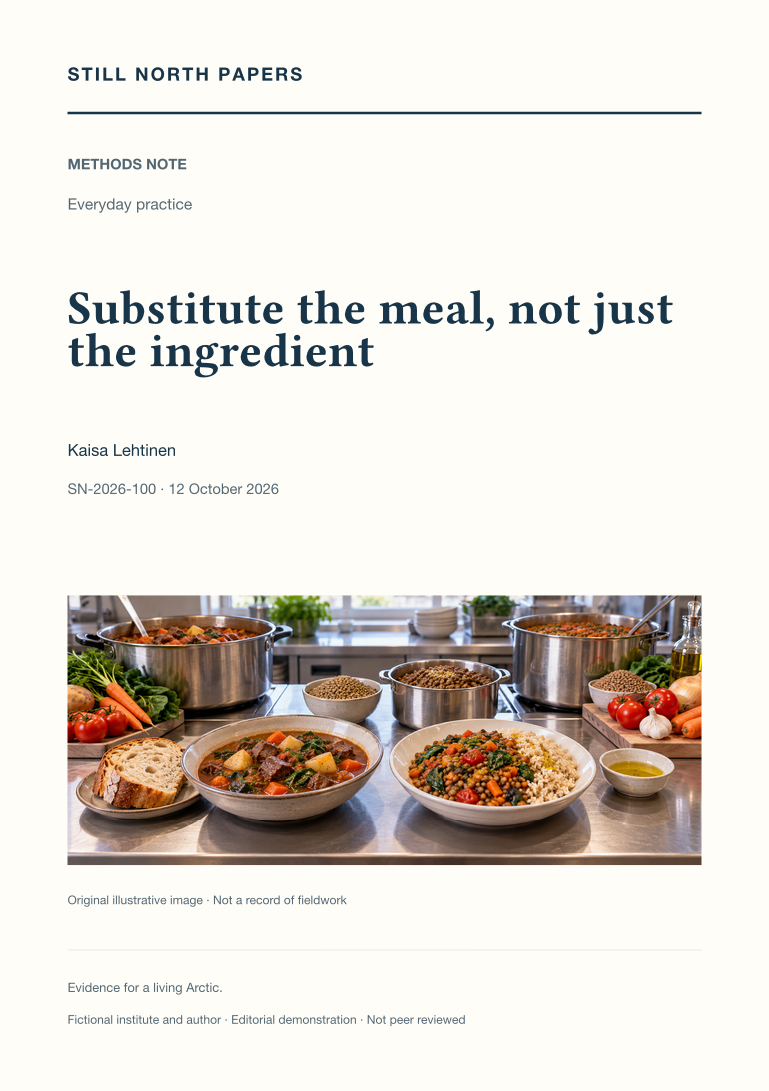
Substitute the meal, not just the ingredient
Food substitutions change recipes, yields, preparation, and the service diners receive, not simply the mass of an ingredient purchased. This methods note develops a complete-meal comparison for a fictional community kitchen using Poore and Nemecek’s harmonised food assessment, FAO and WHO diet principles, and the GHG Protocol Product Standard. It examines raw and cooked units, nutritional constraints, retail boundaries, kitchen energy, losses, coproduct allocation, and the difference between average inventories and marginal consequences. A hypothetical stew comparison identifies missing observations without inventing acceptance results or footprints. No savings or dietary prescription are offered. The practical implication is to assess suitable eating occasions under consistent boundaries while retaining food safety, affordability, cultural acceptability, and access as independent requirements.
The missing peak: a worked missing-not-at-random example
An apparently complete environmental record can underestimate its target when high values are less likely to be retained. This methods note presents a wholly fictional 100-value index series whose response-dependent missingness lowers the observed mean. It compares zero replacement, complete-case averaging, mean imputation, interpolation, and model-based assumptions, then expresses the complete-period mean as a function of the unknown missing-value mean. A sensitivity table and an educational tipping point make the unidentifiable component explicit. Seaman and colleagues' missingness definitions, CF conventions, and observing-network context frame the analysis. No empirical correction, safety threshold, or acceptable completeness percentage is proposed. The note argues for preserving failure information and reporting assumption-dependent conclusions rather than allowing a smooth completed series to conceal selection.

A seat is not a journey: comparing transport on the same unit
Transport comparisons can fail when vehicle-kilometres, passenger-kilometres, seating capacity, and complete journeys are treated as interchangeable. This methods note develops an event-travel comparison using the UK government’s conversion-factor methodology and GHG Protocol product and policy-accounting standards. A fictional twelve-person case illustrates occupancy, detours, positioning, and the risk of rewarding unnecessary distance through a denominator. The analysis distinguishes factors that already contain occupancy assumptions, aligned operating boundaries, average allocation, and marginal consequences. Accessibility and a feasible return journey define the service rather than appearing as optional extras. No real emissions or modal savings are calculated. The resulting record supports comparison of complete, usable journeys while retaining uncertainty about vehicles, routes, factors, and displaced alternatives.
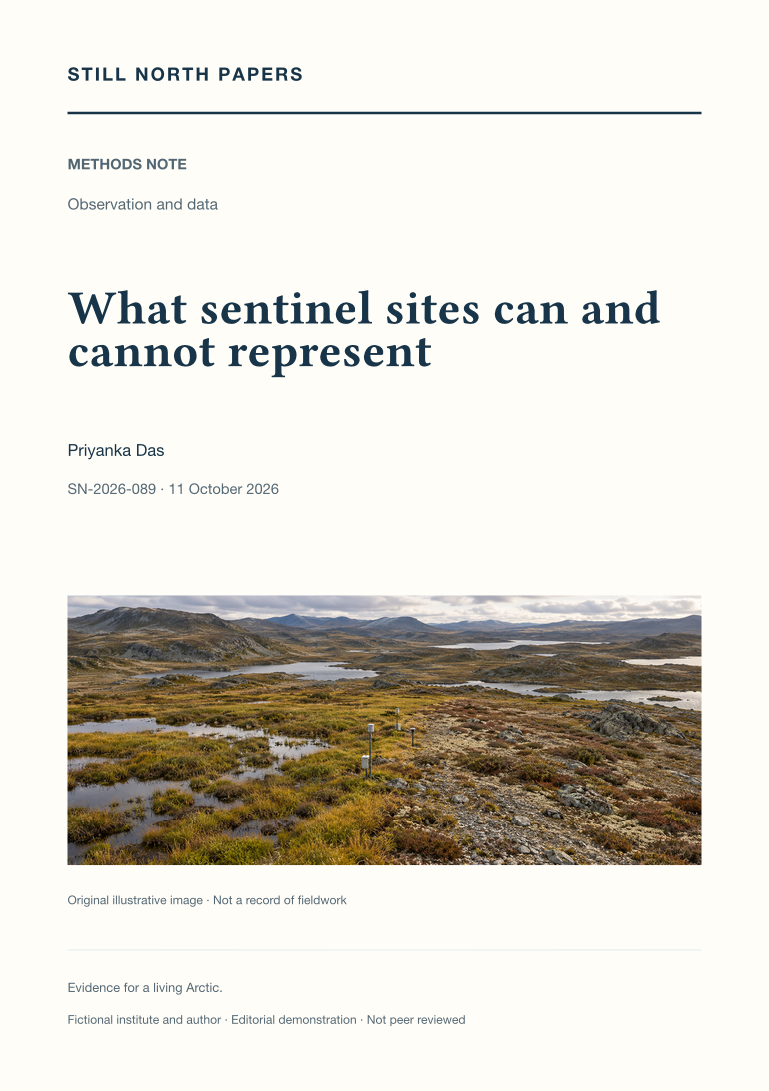
What sentinel sites can and cannot represent
Sites selected for sensitivity or continuity can provide excellent process evidence without representing a region. This methods note combines primary preferential-sampling research, EPA probability-survey guidance, and climate-observing sources to examine that distinction. A fictional catchment census shows how a sentinel network concentrated in sensitive terrain can yield a site fraction far above the regional proportion. The analysis separates population targets, weighting, purposeful selection, probability sampling, and conditional model-based expansion. It considers hybrid networks, transfer-oriented evaluation, changing representativeness, and protected selection records. No actual regional condition or optimal site list is estimated. The implication is to retain detailed sentinel findings and separately justified regional estimates as complementary products, rather than treating repeated measurements at informative sites as a cure for missing population coverage.
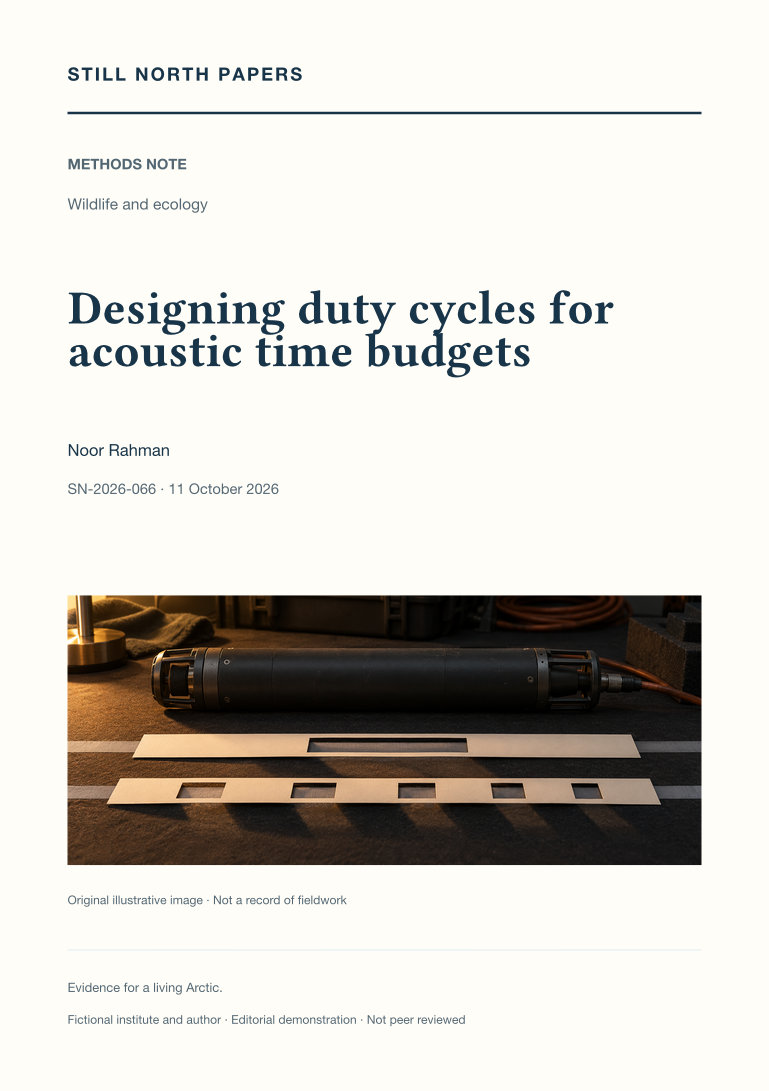
Designing duty cycles for acoustic time budgets
Equal recording effort does not imply equal information about acoustic encounters or their durations. This methods note synthesises published subsampling experiments and diel acoustic research to connect recording schedules with clearly defined time-budget metrics. A hypothetical ten-percent duty-cycle comparison shows that frequent short windows can increase the probability of encountering a brief bout while leaving expected recorded bout time unchanged. The analysis distinguishes daily presence, sampled audible time, call counts, and censored encounter lengths, then examines schedule synchronisation, biological timing, and continuous pilot records. It provides no universal correction factor and does not equate acoustic activity with animal abundance or feeding time. Its practical recommendation is to evaluate the intended metric under candidate schedules rather than selecting a recording percentage alone.

Who keeps the benefit of a warmer rented home?
A retrofit can improve a building without distributing its benefits fairly among current tenants, owners, future occupants, and public funders. This methods note develops a distributional account using Davis’s original appliance-adoption analysis, Fowlie and colleagues’ weatherisation evaluation, and the Magenta Book. A fictional rent-and-bill example distinguishes lower energy expenditure from lower total occupancy costs, while an underheated household illustrates the difference between reduced consumption and improved comfort. The analysis maps authority, payments, disruption, maintenance, and benefit timing, and separates participant transfers from societal resource costs. No housing performance or savings are estimated. Its practical implication is that credible retrofit offers need transparent charging, protection, operational responsibility, and evaluation of who actually receives the intended housing outcomes.
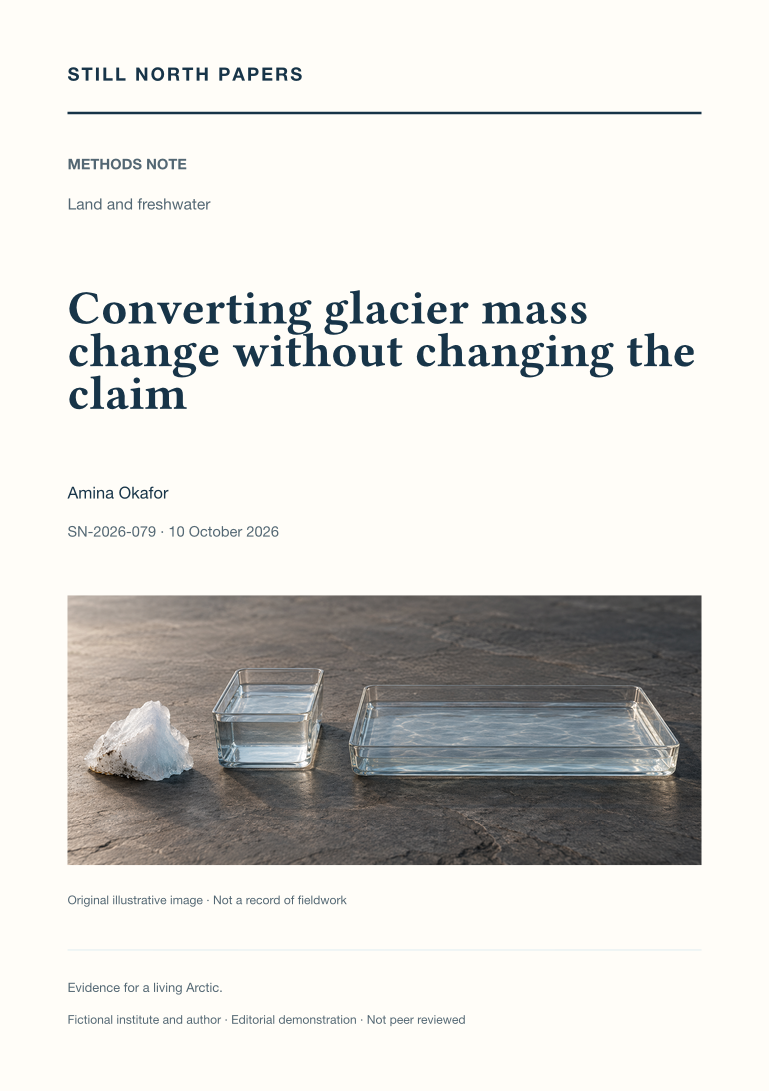
Converting glacier mass change without changing the claim
Glacier change can be expressed per unit area, as total mass, or as a global mean sea-level equivalent, but these quantities support different comparisons. This methods note synthesises the IACS mass-balance glossary, World Glacier Monitoring Service reporting, and NASA sea-level explanations. Fictional glacier calculations demonstrate how rankings reverse between specific and total loss, how sign conventions change between glacier and ocean accounts, and how area uncertainty affects a conversion. The discussion separates rates from cumulative change, water equivalent from surface lowering, and global accounting from local relative sea level. It supplies no original ice-budget estimate or attribution. Its practical result is a reporting sequence that retains dates, area convention, boundary, original units, and uncertainty so a useful translation does not silently become a different scientific claim.
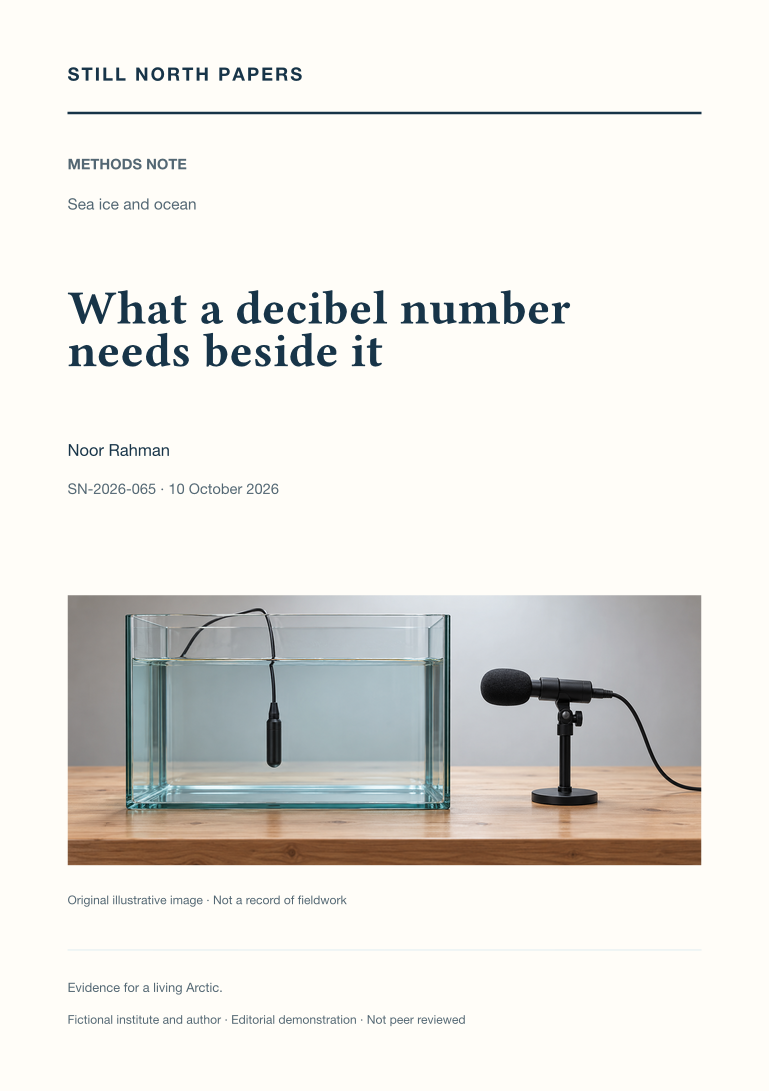
What a decibel number needs beside it
A decibel value becomes comparable only when its physical quantity, reference, frequency support, averaging interval, and calibration are known. This methods note synthesises laboratory guidance and acoustic-methods research to distinguish sound pressure level, peak measures, sound exposure, and spectral density. Hypothetical calculations explain the conventional reference difference between air and water, the effect of duration on exposure, and why averaging logarithmic levels can differ from an energy-equivalent average. The discussion also separates received levels from source levels and pressure measurements from particle motion. It does not establish current regulatory thresholds or biological equivalence between equal exposures. The practical result is a reporting minimum that prevents an apparently precise acoustic comparison from concealing different quantities, processing choices, or measurement limits.

Repair when remaining life is a range
Repair decisions combine a visible quote with uncertainty about restoration, subsequent failure, software support, and the consequences of downtime. This methods note separates those questions through a fictional smartphone case with explicitly invented prices, probabilities, and service periods. European Commission smartphone requirements and repair-policy guidance establish relevant institutional conditions, while the GHG Protocol Product Standard informs the environmental boundary. The analysis explains why expected months are not guaranteed service, why cost per expected month is incomplete, and why deferred replacement must not be counted automatically as permanent avoidance. Financial vulnerability and access needs remain independent constraints. No model-specific reliability or climate benefit is estimated. The proposed conversation connects diagnosis, a defined service horizon, enforceable support, and responsibility for adverse outcomes.