

What a policy pilot can earn permission to scale
A pilot can establish delivery feasibility without resolving effectiveness, additionality, or performance at scale. This methods note develops a reading procedure for a hypothetical repair-voucher programme using the Magenta Book, the CONSORT pilot-trial extension, and Deaton and Cartwright’s methodological analysis. It distinguishes invitation, enrolment, use, repair completion, and sustained service, and explains selection, intention-to-treat comparisons, missing data, uncertainty, and transportability. The fictional planning case contains no completed trial or measured outcomes. Scaling questions include repairer capacity, upfront-payment barriers, changing costs, and different participant populations. No policy saving or climate effect is estimated. The practical implication is to match progression decisions to the pilot’s learning objective, pre-specified criteria, ethical constraints, and the supporting conditions a larger programme would require.
After permission changes in a shared dataset
Changed permission requires an accountable response even when a shared dataset cannot be recalled perfectly. This practice essay compares consent policy, Indigenous research-governance sources, Creative Commons terms, and data-citation guidance. A fictional controlled table released publicly without authorisation illustrates why an original breach, withdrawal from participation, requests to remove data, and discontinuation of a public download must remain distinct. The analysis follows copies, derivatives, backups, recipient notices, revised analyses, and persistent landing pages, separating reported actions from exposure that remains. It neither determines jurisdiction-specific legal duties nor promises universal erasure, and makes no claim to resolve a real community's authority. Its implication is proportionate provenance, legitimate decision routes, honest advance limits, and stewardship capacity that continues after publication and funding end.
What would have happened without the campaign?
A favourable decision after collective action is not automatically an effect caused by that action. This methods note develops a counterfactual evaluation for a fictional workplace transport coalition, drawing on the Magenta Book, the GHG Protocol Policy and Action Standard, and the IPCC demand-side assessment. A pre-existing employer plan illustrates bounded contribution rather than exclusive credit, while invented arrival counts expose the assumptions behind before-and-after and comparison-group arithmetic. The analysis distinguishes mobilisation, decisions, implementation, sustained operation, and downstream climate effects. Participant protection and ethical constraints remain part of the design. No campaign result or emissions saving is claimed. The proposed approach supports honest learning from shared influence, partial gains, and unresolved demands without converting signatures into unsupported carbon totals.
Translating results without translating away uncertainty
Multilingual return of results must preserve the relationship between evidence and claim, not merely reproduce sentence structure. This practice essay compares research-governance sources with W3C accessibility guidance through a fictional seasonal-observation case in which an ambiguous denominator changes the apparent conclusion. It examines qualified translation, technical review, terminology, counts, missing records, chart explanation, confidentiality, and synchronised corrections across written and spoken formats. The discussion distinguishes accessibility from translation quality and separates review roles from endorsement. No actual translations, community consultations, or reader evaluations are reported. The essay rejects treating English as automatically authoritative and offers responsibilities for outside institutions without prescribing a universal Indigenous format. Its central implication is to resource multilingual return as part of evidential integrity throughout a project's lifetime.
A data licence cannot grant consent
A public licence does not summarise every permission governing research material. This practice essay compares Creative Commons Attribution 4.0 legal terms with the National Inuit Strategy on Research, TCPS 2 Chapter 9, and the CARE Principles. A fictional archive containing instrument measurements, place descriptions, and interview excerpts illustrates why possession, copyright authority, individual consent, collective governance, and repository access must remain distinct. The analysis examines irrevocable public grants, incompatible downstream restrictions, attribution without endorsement, and material excluded from a blanket licence. It provides neither legal advice nor a universal Indigenous permission process, and makes no claim of community approval. Clearer separation of objects and authorities can support legitimate reuse while avoiding promises that a repository is not entitled or able to make.
Publishing community maps without exposing lives
Public release changes what a community map can reveal, even when names are removed. This methods note compares NIST de-identification guidance with Indigenous data-governance and Canadian research ethics sources to examine identification, collective exposure, and inference from omissions. A wholly fictional seasonal-observation case contrasts exact points, displaced points, broad zones, and a non-spatial account. It shows why record counts, contributor counts, and complete release packages require separate scrutiny, and why suppressing one cell may not prevent reconstruction. The analysis favours a purpose-led, authorised derivative rather than automatic export of the source map. It provides neither an anonymisation guarantee nor a universal Indigenous checklist, and identifies changing linkage opportunities, review capacity, and irreversible distribution as important limits.
When results make the journey home
Returning research results requires an understandable answer and continuing responsibility, not just a public download link. This essay uses a hypothetical water study to show why a local question must remain visible alongside academic interpretations and why limited samples cannot imply a comprehensive safety assessment. The National Inuit Strategy on Research places usefulness within governance and authority, while W3C guidance informs layered explanations, charts, tables, and accessible alternatives. Formats, language, timing, and correction routes should be agreed before collection, with private ways to raise questions or errors. The discussion distinguishes review from demands for favourable conclusions and protects participation from assumed recording permission. Dated summaries, retained authoritative records, and stewardship beyond the final event help keep the answer reachable after a project ends.
Open data, whose authority?
Easy downloading does not establish authority to reuse a dataset responsibly. This essay reads the National Inuit Strategy on Research as connected commitments to governance, ethics, funding, data control, and capacity, not a transferable permission checklist. A hypothetical reuse of locally shared travel knowledge shows how combining or opening information can introduce risks even when names are removed. TCPS 2 Chapter 9 adds policy context while explicitly not replacing Indigenous peoples' own guidance. The discussion connects agreed authority to repository permissions, review processes, staff handover, and differentiated release terms. It also distinguishes public availability from unrestricted ethical reuse. Useful outcomes may include locally governed information or a decision not to disclose, but those outcomes must be defined with the relevant authorities rather than claimed by outside institutions.
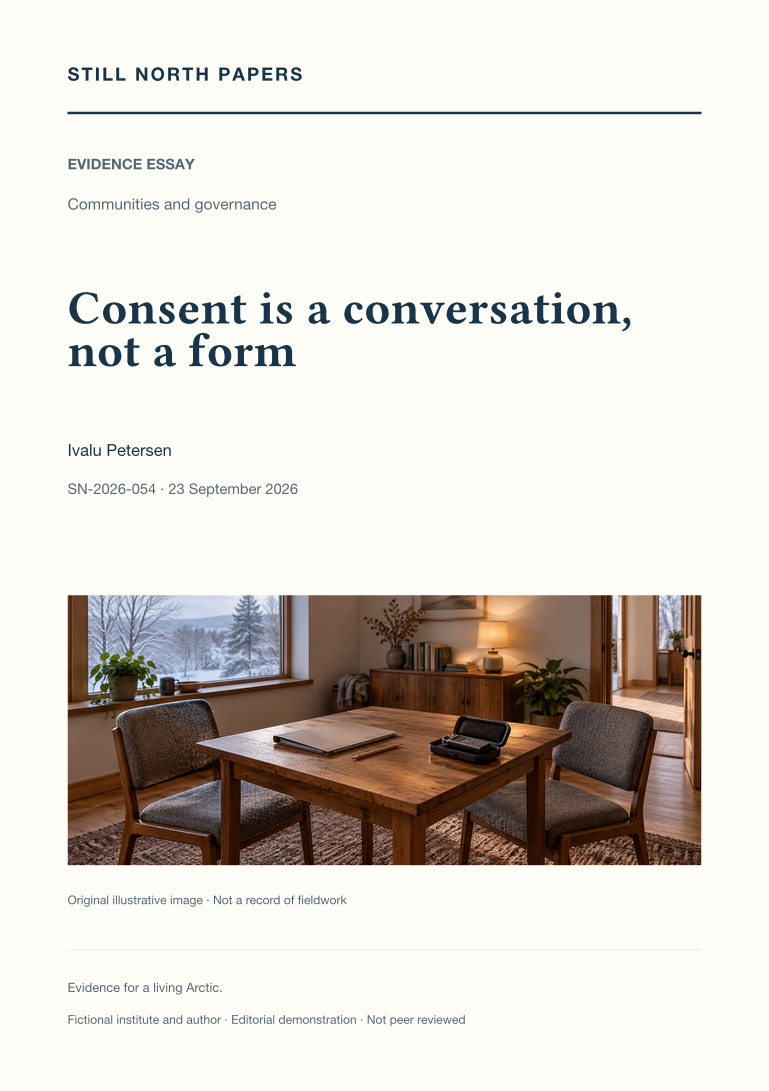
Consent is a conversation, not a form
Consent requires an understandable, voluntary, and continuing choice, not merely a signed form. Using a hypothetical interview about winter conditions, this essay separates participation from permission to publish recordings, locations, or quotations. Canada's TCPS 2 consent guidance informs discussion of explanation, power relationships, recruitment, compensation, and meaningful refusal, while remaining a specific policy rather than a universal legal rule. The National Inuit Strategy on Research helps distinguish individual consent, institutional approval, and collective authority without prescribing local arrangements. Changed projects and new uses may require renewed permission, and withdrawal limits must be explained before participation. The practical conclusion is operational: clear responsibilities, private records, and usable routes to pause, revise, or decline should continue after documentation has been completed.
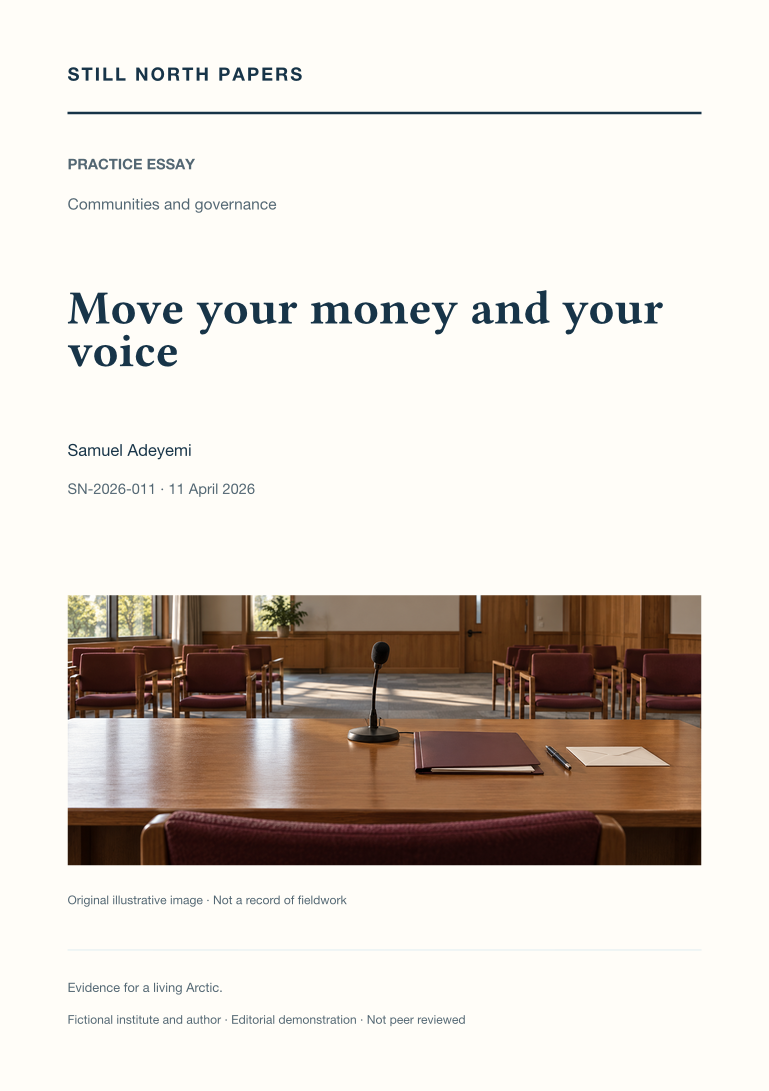
Move your money and your voice
Financial choices and public participation are examined through the decision rights of pensions, banks, employers, suppliers, and public authorities. Rather than ranking institutions with simple climate labels, the essay asks who sets policy, which evidence is public, how exceptions operate, and what follows missed targets. It separates exclusion, engagement, switching, and campaigning by their stated goals and warns that meetings, labels, or customer influence alone do not demonstrate impact. Financial risk, fees, access, and personal circumstances remain outside generic climate advice. Drawing on the cited IPCC assessments for wider context, the practical method is to identify a review date, submit a specific request, and preserve the response. Listening to affected people and maintaining a proportionate public record make follow-up more accountable.