

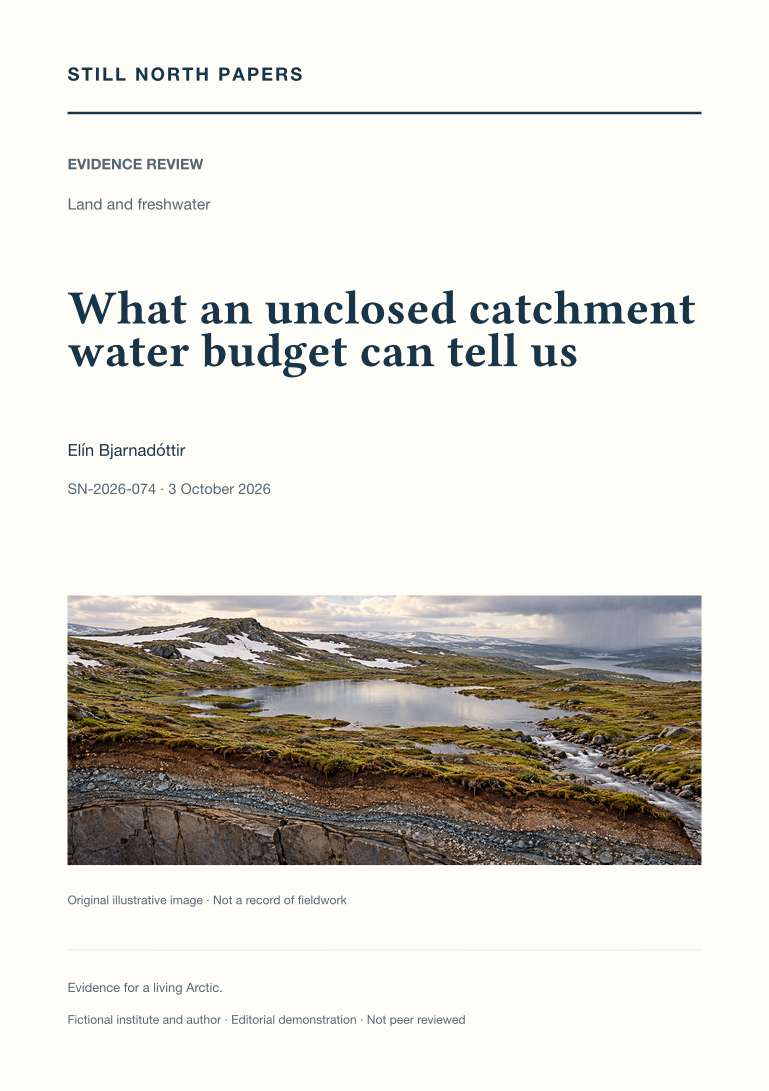
What an unclosed catchment water budget can tell us
An imbalance in a catchment water budget does not identify a missing pathway, and exact closure does not validate every component. This evidence review synthesises two multi-basin closure studies and measurement-uncertainty guidance to develop a diagnostic approach for northern catchments. It examines boundary definitions, compatible units and periods, snow carryover, storage, and dependence between products. A fictional annual account shows why a residual can be small relative to combined uncertainty and why replacing an independent evapotranspiration estimate with a remainder is not validation. Seasonal residual patterns and targeted independent observations are considered as ways to discriminate explanations. The review supplies no universal closure threshold and performs no local assessment. Its conclusion is that retaining the residual and component histories makes a budget more informative than forcing an apparently complete account.
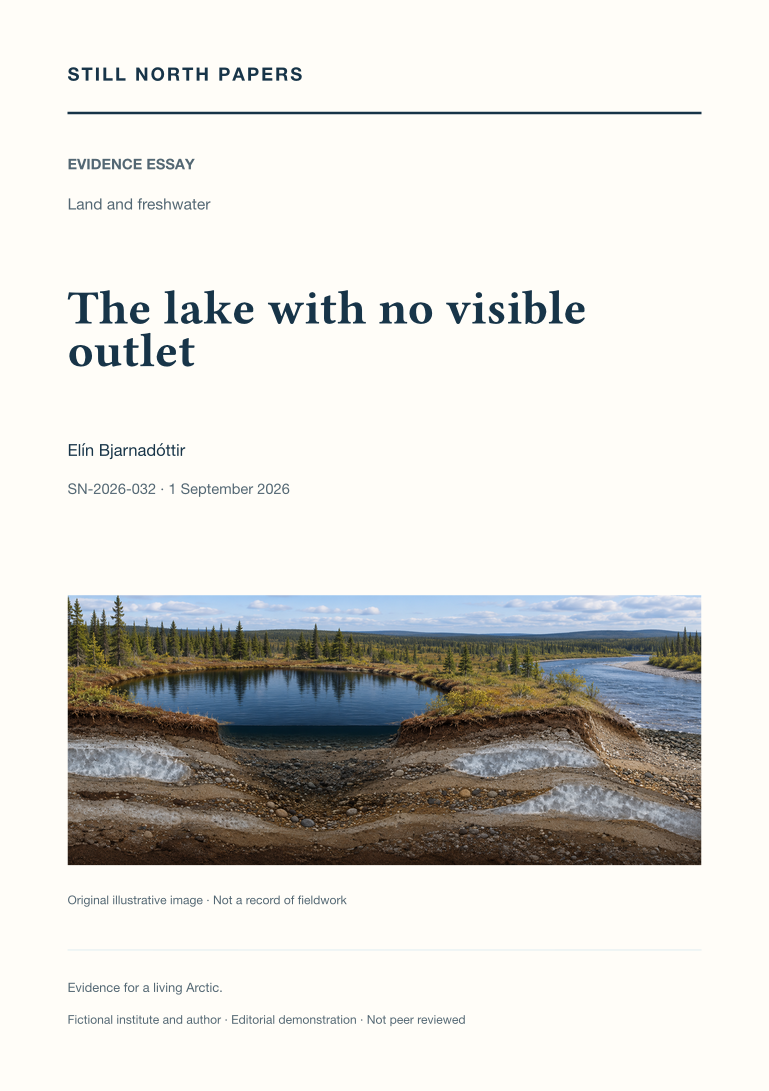
The lake with no visible outlet
A lake without a mapped surface outlet can still exchange water through seasonal floods or subsurface pathways. This essay uses published Yukon Flats research to distinguish observed lake-area change from inferred hydrological connectivity. It explains how permafrost distribution, sediment permeability, and changing water levels influence possible routes, while a shrinking shoreline can reflect several competing changes in the water balance. The account of Twelvemile Lake shows why flood recharge and longer records can alter an interpretation based on isolated images. A hypothetical comparison of neighbouring lakes illustrates the additional evidence needed to separate shared rainfall from direct exchange. The discussion concludes that connectivity must be specified by timing, direction, duration, and purpose rather than treated as a permanent line on a map.