

When a second sensor is not a second network
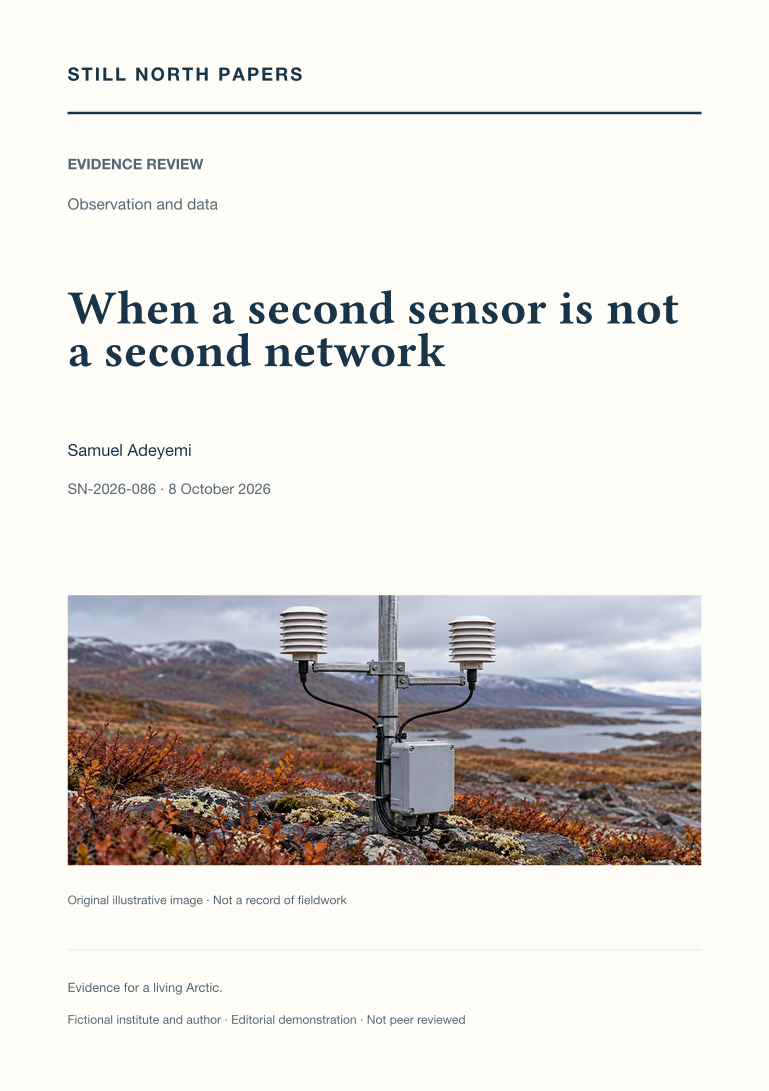
Instrument counts alone do not establish observing-network resilience. This evidence review combines the Arctic observing-network assessment, GCOS monitoring principles, and measurement-uncertainty guidance to distinguish redundancy for availability, accuracy, coverage, and timely delivery. A fictional reliability calculation contrasts independent failures with two instruments sharing a vulnerable platform. Further analysis follows common dependencies through calibration, software, archives, funding, and specialist expertise, while distinguishing environmental correlation from correlated measurement error. The review considers removal experiments and irreversible gaps in long records without ranking actual investments or specifying operational safety coverage. It also rejects treating community-led observation as an interchangeable spare component. Redundancy is most defensible when it protects a named evidential function through an independent, authorised route whose limitations are documented.
Measuring a glacier in footsteps
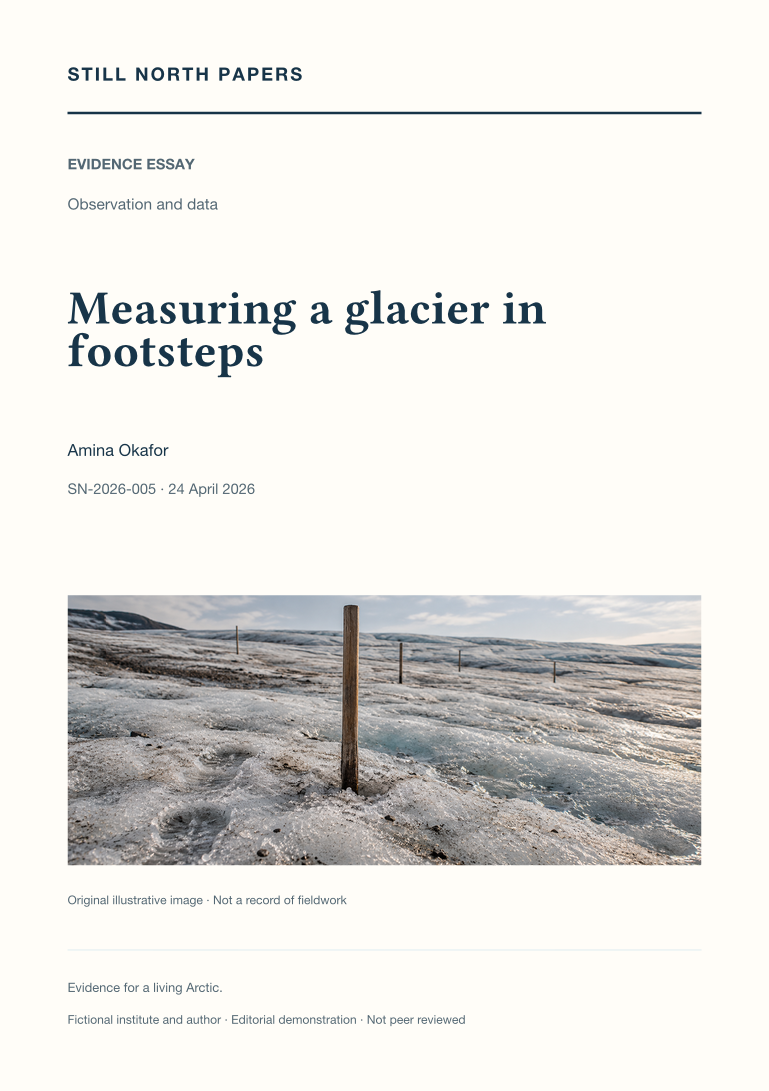
Ablation stakes provide the focus for an illustrative explanation of repeated glacier measurement and its limits. The essay follows stake placement, installation, exposed-length readings, surface conditions, density assumptions, and the records needed when a marker moves, tilts, disappears, or is replaced. A point measurement can describe local surface change, but neither a convenient transect nor a visible row of stakes establishes the mass balance of Greenland. Published regional estimates are therefore placed alongside, rather than attributed to, the field scene, with their uncertainty retained. The account explains how stake networks complement weather observations, satellites, models, and discharge measurements. Its practical conclusion is that continuity depends on explicit reference conventions, representative coverage, raw readings, and honest treatment of interruptions rather than an artificially seamless series.