

Look for a common driver before linking ocean series
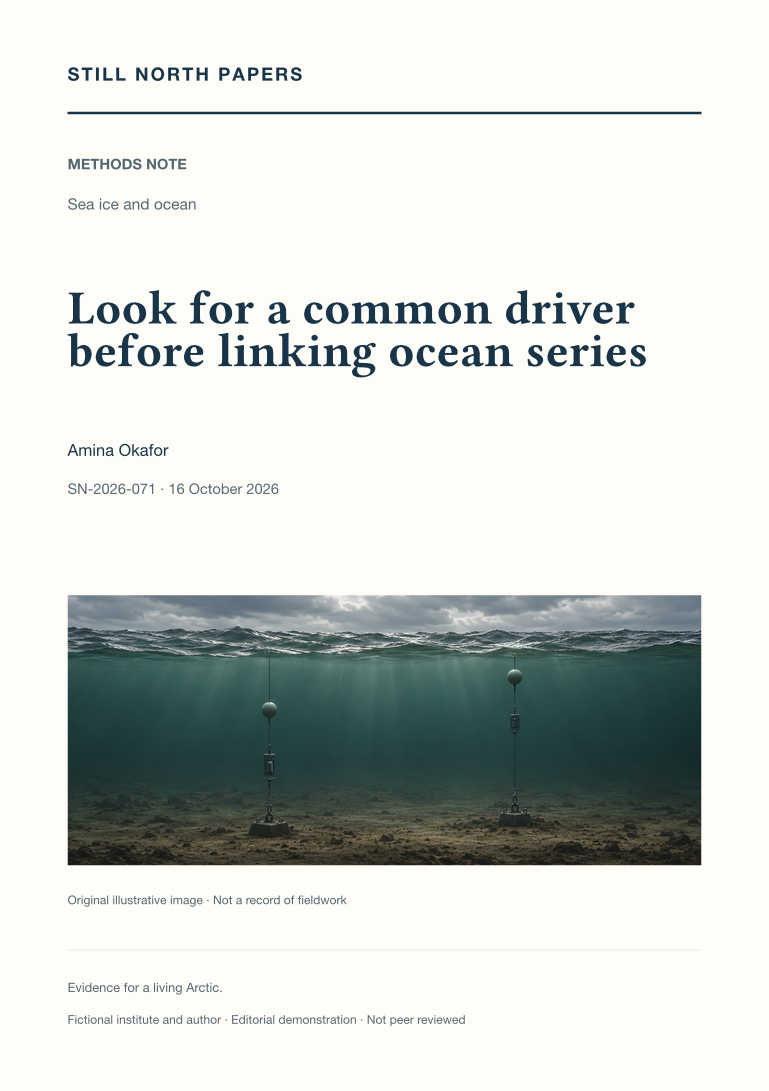
Strong correlation and a plausible lead can arise when two ocean records share a driver rather than directly influence one another. This methods note combines Earth-system causal-inference research with studies of nonlinear ecological dynamics and autocorrelated fish-environment data. An invented two-regime calculation produces a correlation of approximately 0.94 despite zero within-regime association and no constructed direct effect. The analysis then examines lagged common forcing, sampling and smoothing, seasonal transformations, adjustment choices, and the assumptions behind advanced causal methods. It attributes no actual ocean event and does not claim that conditioning alone establishes causation. Its practical outcome is a sequence of rival physical explanations and discriminating observations, allowing unresolved associations to guide a better next measurement instead of an overstated causal story.
A drifting instrument is not a fixed station
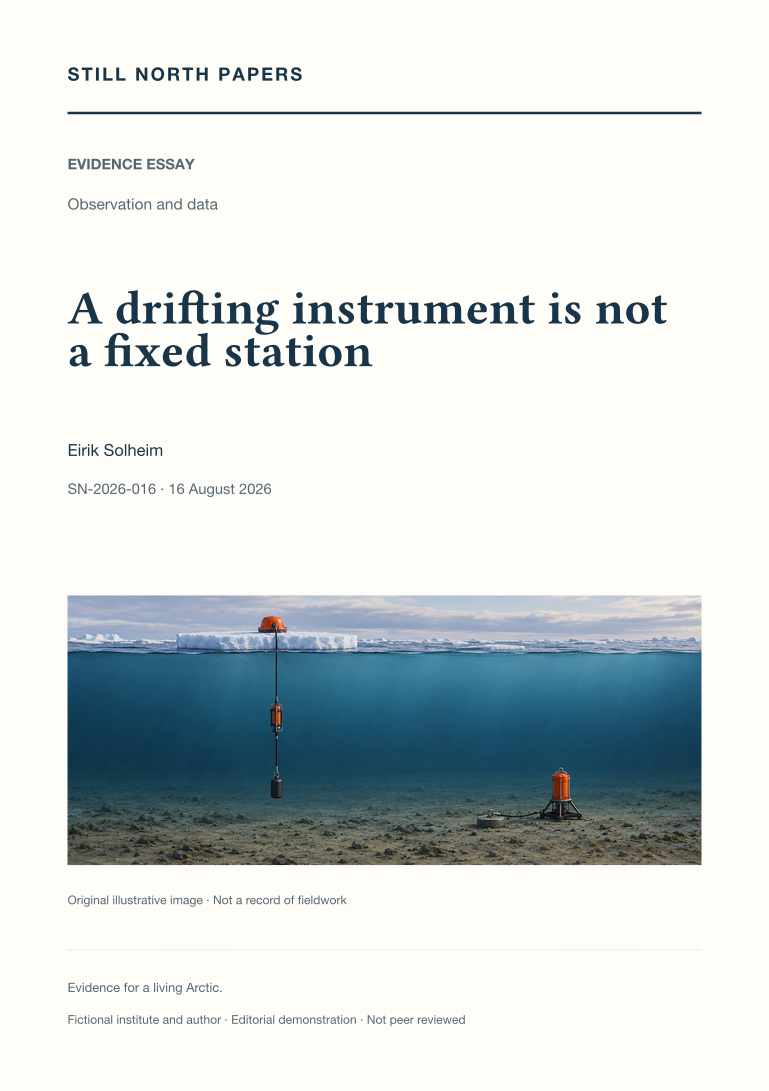
A rising temperature series from a drifting instrument can record a journey across ocean structure rather than local warming. This essay contrasts ice-tethered profilers with anchored instruments and uses an explicitly invented water-mass crossing to separate spatial variation from change through time. It also explains why a fixed mooring can record a displaced current or layer, so anchoring does not remove every interpretive ambiguity. Position, pressure, temperature, salinity, currents, and repeated profiles constrain different alternatives. Maps and depth-distance sections can reveal coverage changes hidden by monthly means, while many neighbouring profiles do not become independent basin-wide samples. Published Arctic ocean assessments provide context for combining viewpoints. The practical implication is to retain platform movement and instrument geometry as explanatory evidence, not remove them from the story.