

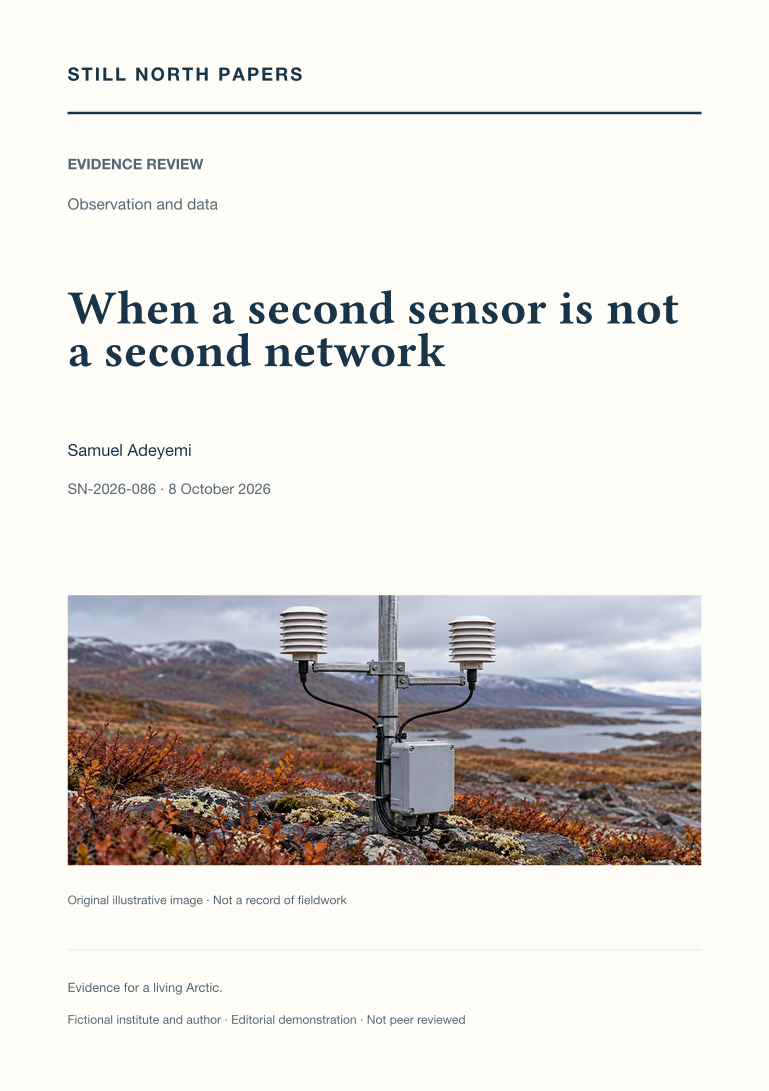
When a second sensor is not a second network
Instrument counts alone do not establish observing-network resilience. This evidence review combines the Arctic observing-network assessment, GCOS monitoring principles, and measurement-uncertainty guidance to distinguish redundancy for availability, accuracy, coverage, and timely delivery. A fictional reliability calculation contrasts independent failures with two instruments sharing a vulnerable platform. Further analysis follows common dependencies through calibration, software, archives, funding, and specialist expertise, while distinguishing environmental correlation from correlated measurement error. The review considers removal experiments and irreversible gaps in long records without ranking actual investments or specifying operational safety coverage. It also rejects treating community-led observation as an interchangeable spare component. Redundancy is most defensible when it protects a named evidential function through an independent, authorised route whose limitations are documented.