

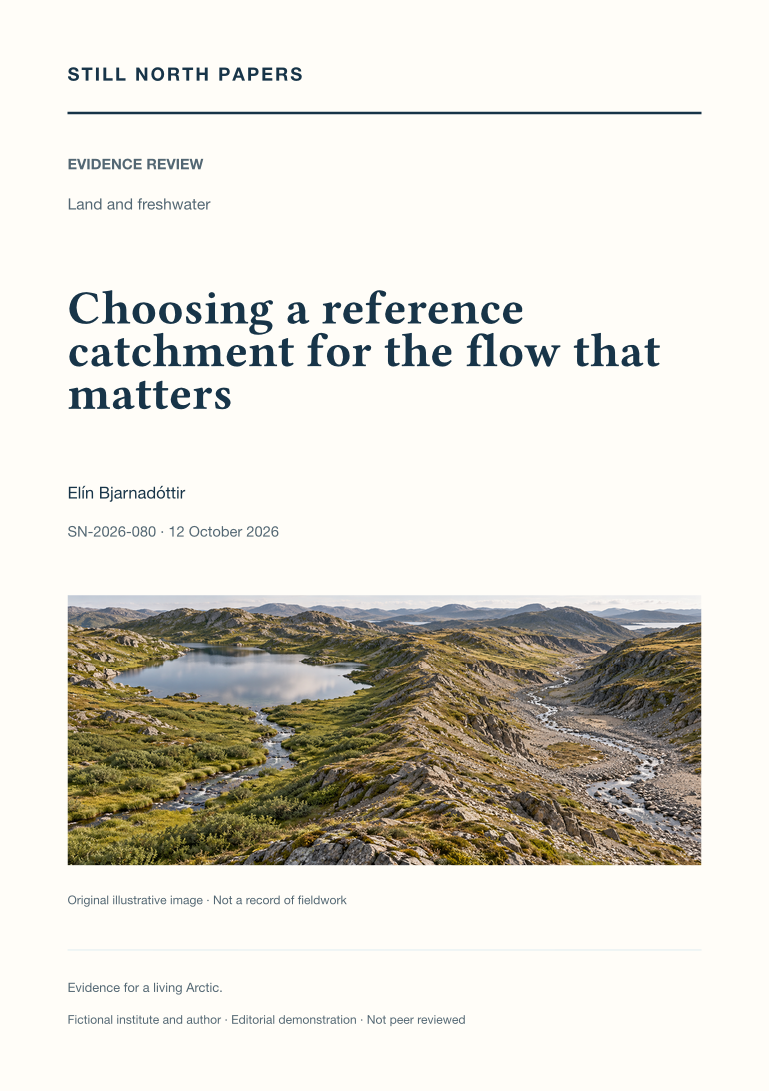
Choosing a reference catchment for the flow that matters
A neighbouring catchment is not automatically a credible hydrological reference. This evidence review synthesises paired-catchment research, reference-by-reference diagnostics, and evidence on catchment-dependent water-balance performance. It argues that selection should begin with the response variable and timescale, distinguishing annual yield, summer low flow, and snowmelt timing. A fictional calibration shows how a reference-gauge change can inflate an apparent target effect even when target observations remain unchanged. The review separates calibration representativeness from later stability and considers multiple references, meaningful temporal validation, extrapolation, stewardship, and monitoring history. It performs no site selection and claims no disturbance effect. Its practical implication is to state exactly which behaviour a reference predicts and how that relationship will be tested, rather than treating proximity or a high overall correlation as sufficient evidence.
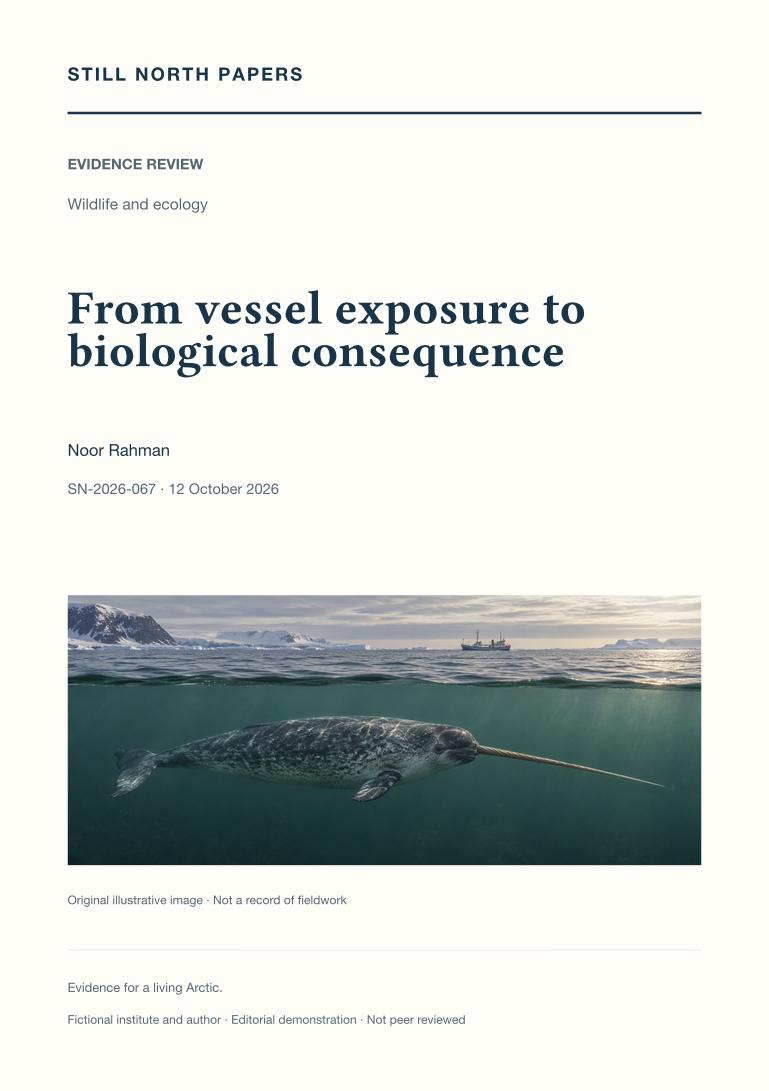
From vessel exposure to biological consequence
Traffic overlap, received sound, individual response, and population consequence describe different stages of an impact assessment. This evidence review compares two narwhal exposure studies with the Population Consequences of Disturbance framework to identify the evidence connecting those stages. It preserves the studies' small exposed samples, male or adult representation, and concurrent sound sources rather than converting their results into universal distance rules. Hypothetical comparisons show why identical animal-hours can distribute exposure differently and why a lower sound level over a longer passage need not reduce integrated exposure. No actual route impact or safe buffer is estimated. The review supports proportionate precaution while distinguishing measured responses, energetic assumptions, demographic inference, and unresolved mechanisms that additional observations would need to constrain.
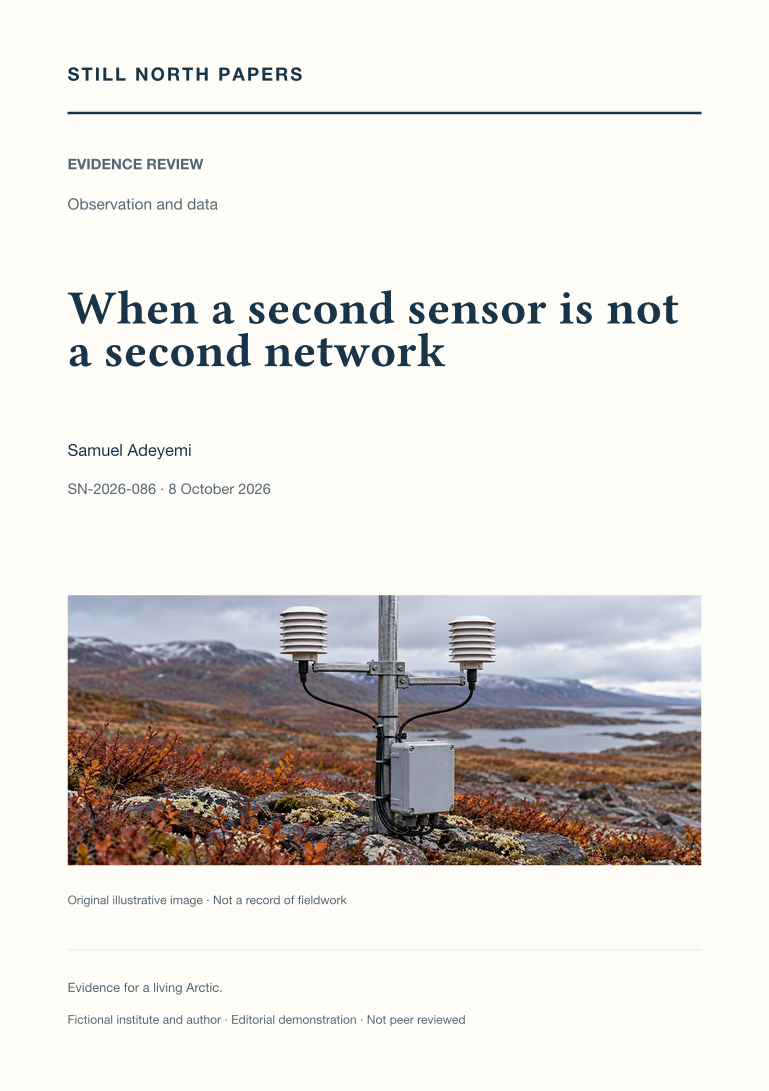
When a second sensor is not a second network
Instrument counts alone do not establish observing-network resilience. This evidence review combines the Arctic observing-network assessment, GCOS monitoring principles, and measurement-uncertainty guidance to distinguish redundancy for availability, accuracy, coverage, and timely delivery. A fictional reliability calculation contrasts independent failures with two instruments sharing a vulnerable platform. Further analysis follows common dependencies through calibration, software, archives, funding, and specialist expertise, while distinguishing environmental correlation from correlated measurement error. The review considers removal experiments and irreversible gaps in long records without ranking actual investments or specifying operational safety coverage. It also rejects treating community-led observation as an interchangeable spare component. Redundancy is most defensible when it protects a named evidential function through an independent, authorised route whose limitations are documented.
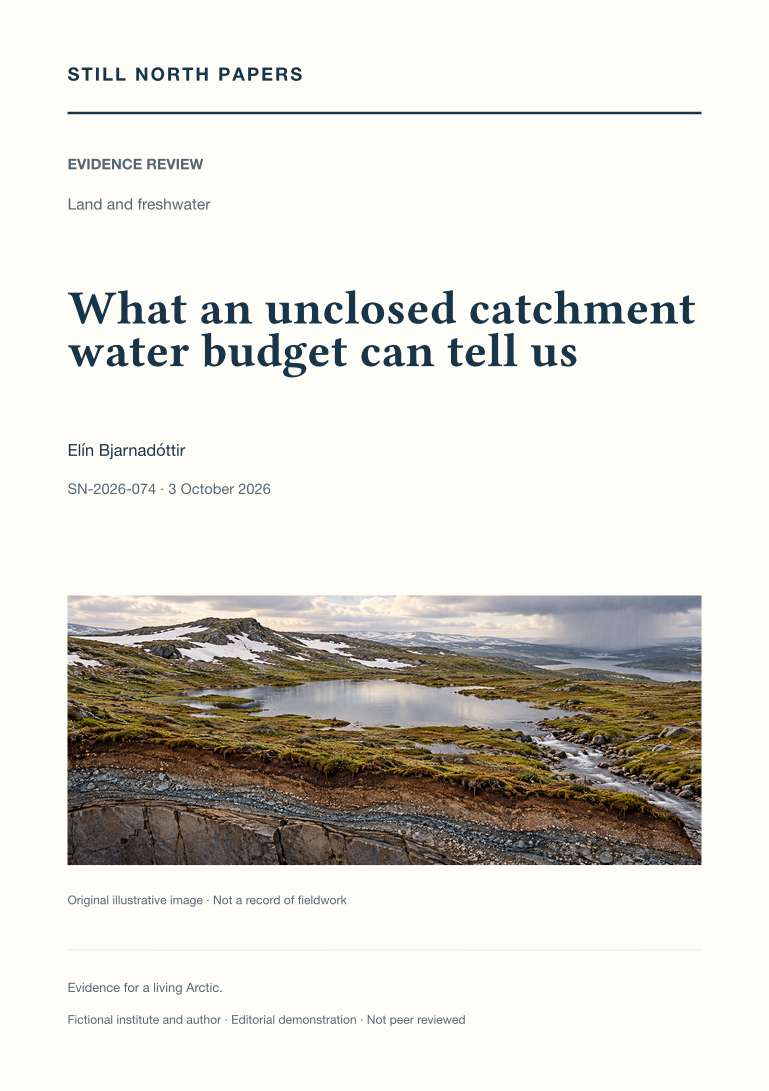
What an unclosed catchment water budget can tell us
An imbalance in a catchment water budget does not identify a missing pathway, and exact closure does not validate every component. This evidence review synthesises two multi-basin closure studies and measurement-uncertainty guidance to develop a diagnostic approach for northern catchments. It examines boundary definitions, compatible units and periods, snow carryover, storage, and dependence between products. A fictional annual account shows why a residual can be small relative to combined uncertainty and why replacing an independent evapotranspiration estimate with a remainder is not validation. Seasonal residual patterns and targeted independent observations are considered as ways to discriminate explanations. The review supplies no universal closure threshold and performs no local assessment. Its conclusion is that retaining the residual and component histories makes a budget more informative than forcing an apparently complete account.